
|
BLOG
News
GET THE LEGAL ASSISTANCE YOU REQUIRE AT THIS MOMENT
|
Facing Eviction in Florida? Here Are the Legal Defenses That Can Save Your Home
Receiving an eviction notice does not mean you have already lost. Florida law gives tenants powerful legal defenses — and knowing them before your court date can make all the difference.
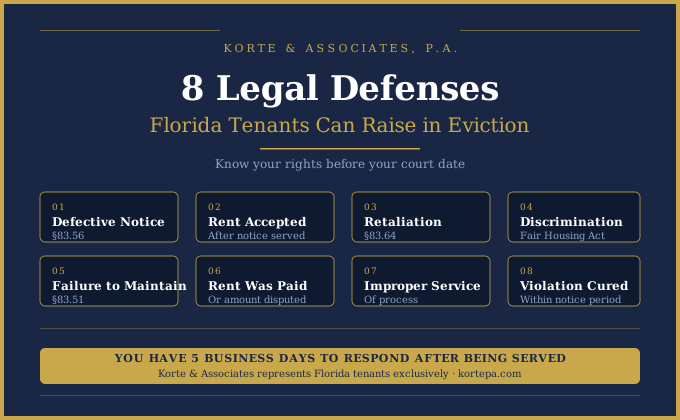
Every year, thousands of Florida tenants are served with eviction papers and assume the process is a done deal. Many never show up to court, not realizing that a landlord must follow strict legal procedures — and that a single misstep on their part can be grounds to dismiss the entire case.
At Korte & Associates, we represent tenants exclusively. We have seen firsthand how the right defense, raised at the right time, can stop an eviction in its tracks. This guide breaks down the most important defenses available to Florida tenants under the Florida Residential Landlord and Tenant Act (Chapter 83, Florida Statutes).
Why You Must Respond — and Fast
In Florida, once you are served with an eviction complaint, you typically have five business days to file a written response with the court. Miss that window and a default judgment can be entered against you — even if you have a valid defense. Time is the most critical factor in any eviction case.
Florida courts count business days only. Weekends and court holidays do not count toward your five-day deadline. If the fifth day falls on a holiday or weekend, you have until the next business day.
Common Defenses Florida Tenants Can Raise
Below are the defenses most frequently available to tenants in Florida eviction proceedings. Not every defense applies to every situation — but each one has stopped evictions when properly raised.
1. Defective Three-Day Notice
Most evictions for nonpayment of rent begin with a three-day notice to pay or vacate. Under Florida Statute §83.56, this notice must contain the exact amount owed, be properly addressed, and be delivered in a legally sufficient manner. If the notice overstates the rent owed (including improperly adding late fees), names the wrong amount, or was delivered incorrectly, the entire eviction may be dismissed.
2. Landlord Accepted Rent After Serving Notice
If your landlord served you with a three-day notice and then accepted a full or partial rent payment, they may have waived their right to evict you. Florida courts have held that acceptance of rent after a notice is served can defeat the eviction action entirely. This is one of the most overlooked defenses and one of the most powerful.
3. Retaliatory Eviction
Under Florida Statute §83.64, a landlord cannot evict you in retaliation for reporting housing code violations, contacting a government agency about conditions in your home, or exercising any right protected under Florida law. If you complained about mold, lack of heat, pest infestations, or other habitability issues shortly before receiving an eviction notice, retaliation may be a defense.
4. Discriminatory Eviction
The Fair Housing Act and Florida law prohibit eviction based on race, color, national origin, religion, sex, familial status, disability, and in many Florida localities, additional protected categories. If you believe you are being evicted for discriminatory reasons, this is both a defense to the eviction and the basis for a separate legal claim.
5. Landlord's Failure to Maintain the Property
Florida Statute §83.51 requires landlords to maintain rental properties in a habitable condition — functioning plumbing, weather protection, pest control, and more. If your landlord has failed to make required repairs, you may have the right to withhold rent or terminate the lease after proper written notice. In an eviction for nonpayment, the landlord's own failure to maintain the unit can be raised as a defense.
6. Rent Was Paid or the Amount Is Disputed
If you have receipts, bank records, or other evidence showing rent was paid — or that the amount claimed is incorrect — that evidence can directly defeat a nonpayment eviction. Always keep copies of every payment you make, whether by check, money order, or electronic transfer.
7. Improper Service of Process
Even if a landlord has a valid reason to evict, they must follow precise legal procedures to serve you with the eviction complaint. If the summons and complaint were not served correctly under Florida law, the court may not have proper jurisdiction to hear the case.
8. Lease Violations Were Cured Within the Notice Period
For evictions based on lease violations other than nonpayment of rent, Florida law generally requires a seven-day notice giving you the opportunity to cure the violation. If you fixed the problem within that window and your landlord still filed for eviction, the case may not be able to proceed.
What Happens If You Do Nothing
If you receive an eviction complaint and do not file a written response within five business days, the court will almost certainly issue a default judgment against you. This means a writ of possession can be issued, and the sheriff can remove you from your home — sometimes with as little as 24 hours' notice after the writ is served.
Even if you believe the eviction is valid, responding preserves your rights, buys time, and may allow you to negotiate a better outcome — including more time to move or a payment arrangement to avoid an eviction on your rental record.
Frequently Asked Questions
Can I be evicted without going to court in Florida?
No. Florida law requires a landlord to file an eviction lawsuit and obtain a court order before you can be removed from your home. A landlord who changes your locks, removes your belongings, or shuts off utilities to force you out is committing an illegal "self-help" eviction — which is itself a violation of Florida law.
Does filing for bankruptcy stop an eviction?
In some circumstances, filing for bankruptcy triggers an "automatic stay" that temporarily halts eviction proceedings. However, the rules are complex and depend on where you are in the eviction process. Speak with an attorney before assuming bankruptcy will protect you from eviction.
What if I can't afford an attorney?
Many tenant rights attorneys, including our firm, handle eviction defense cases on a fee structure designed to be accessible. Florida law also provides for attorney's fees in certain landlord-tenant disputes, which can affect how your case is handled. Contact us for a consultation — there is no cost to speak with us.
How long does the eviction process take in Florida?
An uncontested eviction can move quickly — sometimes within two to three weeks from the filing of the complaint. However, when a tenant files a written response and raises valid defenses, the process is significantly extended. This is one of the most important reasons to respond immediately.
The Bottom Line
An eviction notice is not the end of the road. Florida law gives tenants real, enforceable rights — but only if those rights are exercised in time and in the correct way. The defenses described above have helped countless tenants remain in their homes, negotiate better outcomes, and hold landlords accountable for their own violations.
If you have received an eviction notice, do not wait to see what happens. Every day matters.
Find out if you have legal defenses in 2 minutes — take our free case evaluation at kortepa.com/free-case-evaluation