
|
RESOURCES
What Happens When a Florida Landlord Misses the 30-Day Security-Deposit Notice Deadline?
|
What Happens When a Florida Landlord Misses the 30-Day Security-Deposit Notice Deadline?
Florida law draws a deliberate line between the tenant's protected deposit and any independent damages claim. When the ordinary notice rule applies, a landlord who misses the 30-day deadline must return the fund and cannot use it as a setoff, even though a separate lawsuit may remain available.
Direct Answer:
Under Florida Statute section 83.49(3)(a), a landlord who was required to provide a security-deposit claim notice but failed to do so within 30 days forfeits the right to impose a claim on the deposit and may not seek a setoff against it. The deposit must be returned. The landlord may still file an independent action for damages, but only after returning the protected fund. This consequence assumes that subsection (3)(a)'s notice duty applies; subsection (5) creates a separate, fact-dependent issue discussed below.
|
Florida law separates the deposit from the damages claim
A security deposit is a specific fund held for the tenant's benefit until money is actually due to the landlord. Section 83.49 regulates how that fund is held, when it must be returned, and what a landlord must do before deducting from it. The landlord may also possess an ordinary contract or property-damage claim. Those are related interests, but they are not the same legal thing.
The distinction matters because the Legislature imposed a fund-specific consequence for missing the notice deadline. It did not say every underlying debt disappears. It said the landlord loses the right to impose the claim on the deposit and may not seek a setoff against that fund. It then preserved a separate damages action after return of the deposit.
Authority:
Fla. Stat. § 83.49(1), (3)(a) (2026).
The protected fund
The deposit must be returned if the landlord loses the statutory right to claim or set it off. The court should not use that same fund to pay alleged damages.
The independent claim
The landlord may sue separately, prove liability and damages, and enforce a judgment through the ordinary process after returning the deposit.
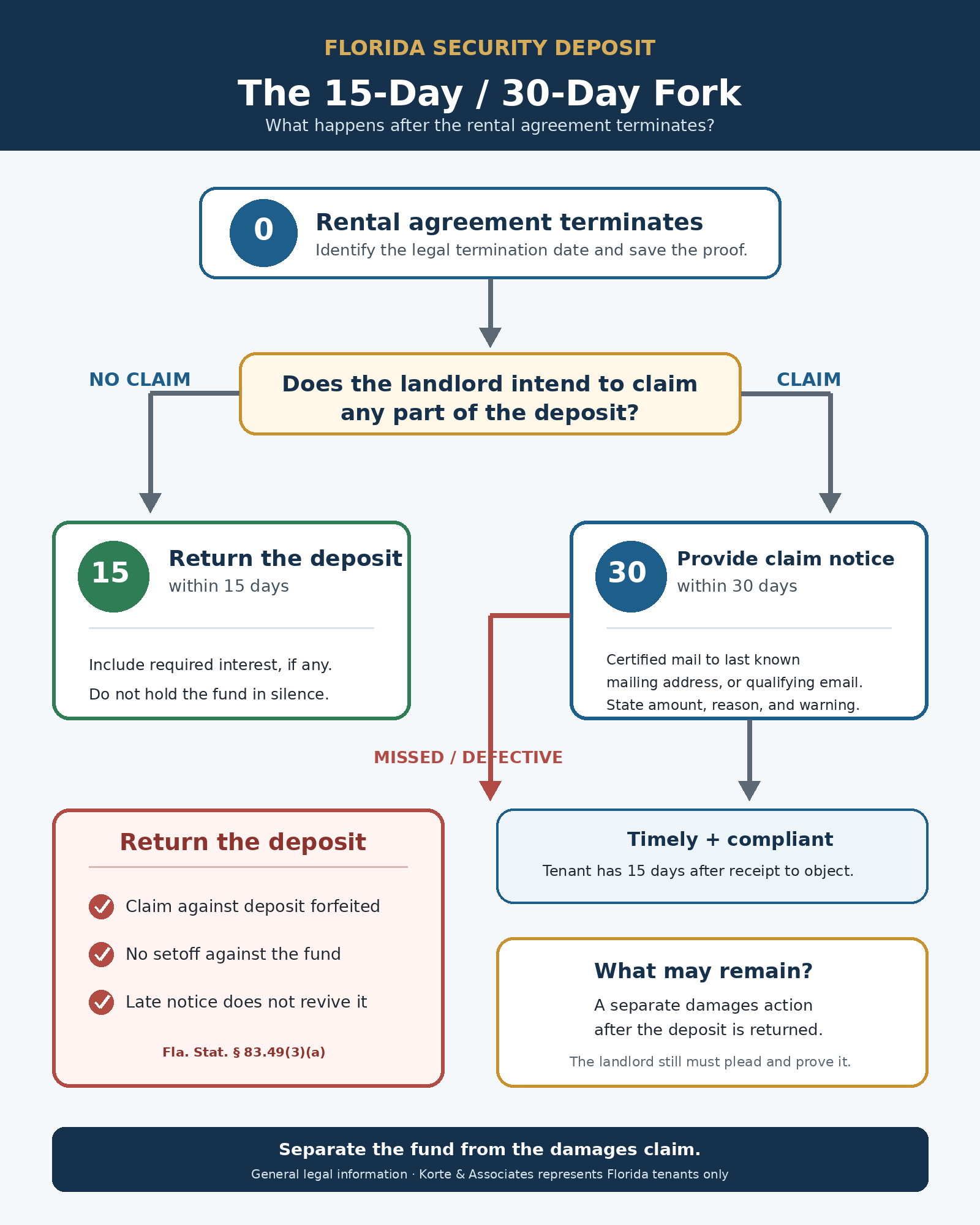
The deadline controls access to the deposit, not whether every possible damages theory exists.
The two ordinary deadlines after termination
No claim: return within 15 days
When the landlord does not intend to impose a claim, section 83.49(3)(a) requires return of the security deposit, together with any required interest, within 15 days after termination of the rental agreement. The landlord cannot avoid that route by remaining silent while deciding indefinitely whether deductions might be asserted later.
A claim: provide notice within 30 days
When the landlord intends to impose a claim, the landlord must provide the prescribed written notice within 30 days after termination. The current statute authorizes certified mail to the tenant's last known mailing address or email only through the voluntary process in section 83.505. The notice must state the amount and reason and contain language substantially matching the statutory form.
The 30-day route is not merely an accounting preference. It tells the tenant that the landlord intends to take money from the protected fund, fixes the asserted amount and reason near the time of move-out, and triggers the tenant's 15-day objection period after receipt.
Authority:
Fla. Stat. § 83.49(3)(a)-(b) (2026);
Fla. Stat. § 83.505 (2026).
What counts as missing the deadline
The clearest failure is no notice at all within 30 days. But timing is only one element of compliance. The Second District held in Wootton v. Iron Acquisitions, LLC that section 83.49 requires strict compliance. The landlord's letter there did not substantially track the statutory warning and was sent to the tenants' attorney rather than their last known mailing address. The court rejected substantial compliance and required return of the deposit.
A tenant should therefore examine at least four questions:
- Was the notice provided within 30 days after the legally relevant termination date?
- Was it sent by certified mail to the last known mailing address or by valid section 83.505 email?
- Did it state the amount and reason for the proposed claim?
- Did it contain the required warning substantially in the statutory form?
A text, portal balance, move-out statement, ordinary email without a valid section 83.505 election, or late certified letter may help show what the landlord asserts. It does not automatically satisfy the statutory claim-notice procedure.
Authority:
Wootton v. Iron Acquisitions, LLC, 338 So. 3d 425, 426-27 (Fla. 2d DCA 2022).
Durene explains why setoff is prohibited
In Durene v. Alcime, 448 So. 2d 1208 (Fla. 3d DCA 1984), the landlord held the deposit beyond the statutory period without giving the required claim notice. The Third District separated three consequences. First, the landlord lost access to the particular, readily available fund. Second, the prevailing tenant was entitled to fees and costs in the deposit action. Third, the landlord could still litigate an independent damages claim, but had to prove it and enforce any judgment through ordinary procedures.
The court rejected even a setoff for damages the tenant had admitted. Once the notice violation caused forfeiture of the deposit claim, the fund was no longer available to the landlord or the court as payment for damages. That holding gives effect to every part of the statute: return the deposit, preserve the independent claim, and prohibit use of the fund as a shortcut.
Durene applied an earlier version of the statute with a shorter notice period. The current statute supplies 30 days for a claim notice, but the same separation is now stated directly in section 83.49(3)(a).
Authority:
Durene v. Alcime, 448 So. 2d 1208, 1209-10 (Fla. 3d DCA 1984);
Fla. Stat. § 83.49(3)(a), (c) (2026).
A late notice does not revive a forfeited deposit claim
The statute ties forfeiture to failure within the 30-day period. A letter sent on day 31 or later cannot make the earlier failure disappear. The late document may identify the landlord's theory for a later damages case, and it may give the tenant useful evidence, but it does not restore statutory access to the deposit.
The same principle prevents a landlord from relabeling a setoff as a judgment credit. If the court first determines that the landlord forfeited the deposit claim, the deposit should be returned as its own fund. A later damages judgment may be collected under ordinary law. Collapsing the two steps would produce the setoff the statute expressly forbids.
The landlord still bears the burden on a separate damages claim
Preserving a separate action does not mean the landlord automatically wins it. The landlord must plead and prove a legally recoverable claim. Depending on the allegation, disputed issues may include:
- whether unpaid rent was actually due and correctly calculated;
- whether the landlord selected and complied with an available remedy under section 83.595;
- whether claimed repairs were caused by the tenant rather than ordinary wear, age, prior conditions, or the landlord's maintenance failures;
- whether invoices, photographs, estimates, and witness testimony reliably prove the amount;
- whether the landlord mitigated avoidable rental losses;
- whether concessions, payments, insurance, or a prior judgment already accounted for the same loss; and
- whether the requested recovery would create an impermissible double recovery.
The security-deposit deadline therefore changes leverage and procedure. It forces a landlord who ignored the fund-protection rules to become the claimant, establish the case, and bear the ordinary risk of collection rather than taking the tenant's money first.
Authority:
Fla. Stat. § 83.595 (2026);
Fla. Stat. § 83.49(3)(a) (2026).
The tenant's address remains part of compliance
The certified-mail destination is the tenant's “last known mailing address.” Korte & Associates' tenant-side position is that this is a knowledge standard: the controlling address is the tenant's correct mailing address actually known to the landlord when performance is due. Section 83.49(3)(a) does not say that knowledge counts only if the tenant used a landlord form, certified mail, the lease notice channel, the landlord's office address, or an update the landlord formally acknowledged.
Evidence of knowledge may come from correspondence, pleadings actually delivered to the landlord or counsel, payment records, texts, emails, prior mailings, property-management records, testimony, admissions, and tracking documents. Mailing to a knowingly obsolete address is not the same as a timely mailing to the correct last known address.
Pierre Woodland Meadows, LLC v. KAC 2021-1 LLC and Motif Apartments LLC v. Tenant's First, LLC should be read narrowly. Both involved venue records in which an address filing had not been effectively delivered to the landlord. They show why proof connecting an address update to landlord knowledge matters; they do not replace the statutory phrase “last known mailing address” with a universal formal-service rule.
This series treats the complete knowledge issue in What “Last Known Mailing Address” Means Under Florida Security-Deposit Law. The separate place-of-payment and small-claims venue analysis is reserved for a later installment.
Authority:
Fla. Stat. § 83.49(3)(a) (2026);
Pierre Woodland Meadows, LLC v. KAC 2021-1 LLC, 377 So. 3d 625 (Fla. 4th DCA 2024);
Motif Apartments LLC v. Tenant's First, LLC, 418 So. 3d 200 (Fla. 4th DCA 2025).
Failed delivery and management changes do not erase the evidence
A returned envelope does not answer every compliance question. Actual receipt is not stated as a universal prerequisite to the landlord's 30-day duty: subsection (3)(a) identifies the delivery method and address, while subsection (3)(b) separately measures the tenant's objection period from receipt. But a landlord cannot create a compliant record by choosing an address it knows is wrong.
Similarly, a landlord should not benefit from its own notice failure. Section 83.50 requires disclosure of a landlord or authorized notice recipient and keeps that authority in place until the tenant is notified otherwise. If management changes without proper notice, a tenant's delivery to the still-authorized address remains important evidence. Section 83.49(7) also requires transfer of the deposit and an accurate tenant accounting to a new owner or agent. An internal handoff should not make the deposit or known address disappear.
Refused or unclaimed certified mail is fact-sensitive. Preserve the mailing receipt, complete tracking history, returned envelope, contents, disclosed address, and any proof of refusal, nonclaim, or management change. Florida appellate courts have not supplied one universal receipt rule for every section 83.49 notice scenario. A tenant should use redundant provable delivery when possible, but a landlord should not be allowed to defeat a statutory consequence by making its own delivery channel fail.
Authority:
Fla. Stat. § 83.50 (2026);
Fla. Stat. § 83.49(3), (7) (2026).
The subsection (5) defense must be analyzed before declaring forfeiture
A careful tenant-side analysis must address section 83.49(5). When that subsection governs, certain tenants leaving before a fixed term expires or leaving a periodic tenancy must give at least seven days' written notice by certified mail or personal delivery before vacating and include an address where they may be reached. Failure relieves the landlord of subsection (3)(a)'s notice requirement, but expressly does not waive the tenant's right to the deposit.
Plakhov v. Serova and Martinez v. Roads Point Townhomes, Inc. recognize that when subsection (5) relieves the landlord of the notice duty, the parties may litigate substantive entitlement without the landlord's procedural forfeiture. Those decisions are serious adverse authority where the facts actually place the tenant within subsection (5).
They do not decide the different question presented by landlord-initiated termination. Korte & Associates' position is that subsection (5) governs a tenant's voluntary departure from an otherwise continuing tenancy, not a departure caused by a landlord's termination or eviction. Section 83.56(6) directs the landlord to comply with subsection (3) after termination, and a landlord cannot demand possession in three days while insisting the tenant should have announced the same departure seven days beforehand. No reported Florida appellate decision has squarely resolved that conflict, so the position must be labeled unsettled.
That scope issue is analyzed fully in Does Florida Statute 83.49(5) Apply After an Eviction?.
Authority:
Fla. Stat. § 83.49(5) (2026);
Fla. Stat. § 83.56(6) (2026);
Plakhov v. Serova, 126 So. 3d 1221, 1223 (Fla. 4th DCA 2012);
Martinez v. Roads Point Townhomes, Inc., 395 So. 3d 667 (Fla. 3d DCA 2024).
What tenants should preserve and do
- Fix the termination date. Save the lease, termination notice, surrender record, eviction judgment, writ, key receipt, and any written agreement about the final possession date.
- Save the actual deposit documents. Keep proof of payment, the lease deposit clause, deposit-account disclosure, renewals, transfer notices, and management correspondence.
- Preserve every delivery record. Keep the letter, envelope, certified-mail receipt, tracking, email header, section 83.505 addendum, portal screenshot, and any returned-mail notation.
- Prove the known address. Save correspondence, pleadings, payment records, texts, emails, prior mailings, management records, admissions, and testimony showing the landlord knew the correct address.
- Do not discard a late notice. It may establish the date, the amount asserted, the landlord's reason, or an admission that the deposit remained under the landlord's control.
- Dispute both procedure and substance. A tenant can argue the deposit claim was forfeited and, separately, that the alleged rent or damage is unproven, inflated, ordinary wear, unmitigated, or already paid.
- Avoid informal setoff language. If the landlord says a court should simply “credit” the deposit against damages, identify section 83.49(3)(a)'s no-setoff language and Durene.
- Evaluate fees carefully. Section 83.49(3)(c) awards costs and a reasonable attorney's fee to the prevailing party in an action adjudicating the right to the deposit, and the court must advance the case on its calendar.
Frequently Asked Questions
What happens if a Florida landlord misses the 30-day security-deposit notice deadline?
When subsection (3)(a)'s notice duty applies, the landlord forfeits the right to impose a claim on the deposit and may not set off alleged damages against it. The deposit must be returned.
Can the landlord still sue me?
Yes. The statute permits a separate damages action after the landlord returns the deposit. The landlord must still prove the claim and cannot use the forfeited deposit as automatic payment.
Can a late letter count as timely notice?
No. A letter provided after the 30-day period does not undo the statutory forfeiture. Keep it because it may still contain useful admissions or evidence about the landlord's alleged damages.
Does the landlord have to prove I received the certified letter?
The statute does not make actual receipt a universal element of the 30-day mailing duty; it directs the landlord to use certified mail to the last known mailing address and measures the objection period from receipt. The address, mailing proof, returned-mail reason, and any section 83.505 email election must all be examined.
What if the notice went to an address the landlord knew was old?
That supports a strong noncompliance argument. “Last known mailing address” should mean the correct address actually known to the landlord, however that knowledge was reliably acquired. Preserve proof that the landlord received or used the updated address.
Does eviction excuse the 30-day notice?
Korte & Associates' position is that landlord-initiated termination does not excuse it because section 83.56(6) directs compliance with subsection (3). Section 83.49(5) creates an unresolved contrary argument, addressed in the prior installment.
Continue the series
- Florida Evictions and Security Deposits: The Complete Guide to Section 83.49(5)
- Week 2: Does Florida Statute 83.49(5) Apply After an Eviction?
- Week 3: What “Last Known Mailing Address” Means
- Florida Security Deposit Recovery for Tenants
Editorial and legal-information disclosure: Korte & Associates represents Florida tenants exclusively. This article distinguishes settled statutory consequences from an unsettled tenant-side interpretation of subsection (5) after landlord-initiated termination. It provides general legal information, not advice for a particular matter. The governing statutory version, lease, termination history, notice records, claims, and later authority may change the analysis.