
|
RESOURCES
Florida Evictions and Security Deposits: The Complete Guide to Section 83.49(5)
|
Florida Evictions and Security Deposits: The Complete Guide to Section 83.49(5)
Does a Florida landlord still have to send a security-deposit claim notice after evicting a tenant? The better reading of Florida law is yes: landlord-initiated termination triggers the landlord's duties under sections 83.49(3) and 83.56(6). A forwarding address helps the tenant receive the notice, but it does not create the landlord's duty to send one.
The short answer
An eviction does not automatically give a Florida landlord the tenant's security deposit. When the landlord terminates the rental agreement, section 83.56(6) says the landlord “shall comply” with section 83.49(3). If the landlord intends to keep any portion of the deposit, the landlord must timely send the statutory notice of intent to impose a claim to the tenant's last known mailing address—or use qualifying e-mail when section 83.505 applies.
If the tenant never supplied a forwarding address, the landlord does not get to send nothing. The landlord must use the last mailing address actually known, which may be the leased premises. Tenants should nevertheless provide a forwarding address in writing because doing so increases the chance of actual receipt and eliminates an avoidable factual dispute.
|
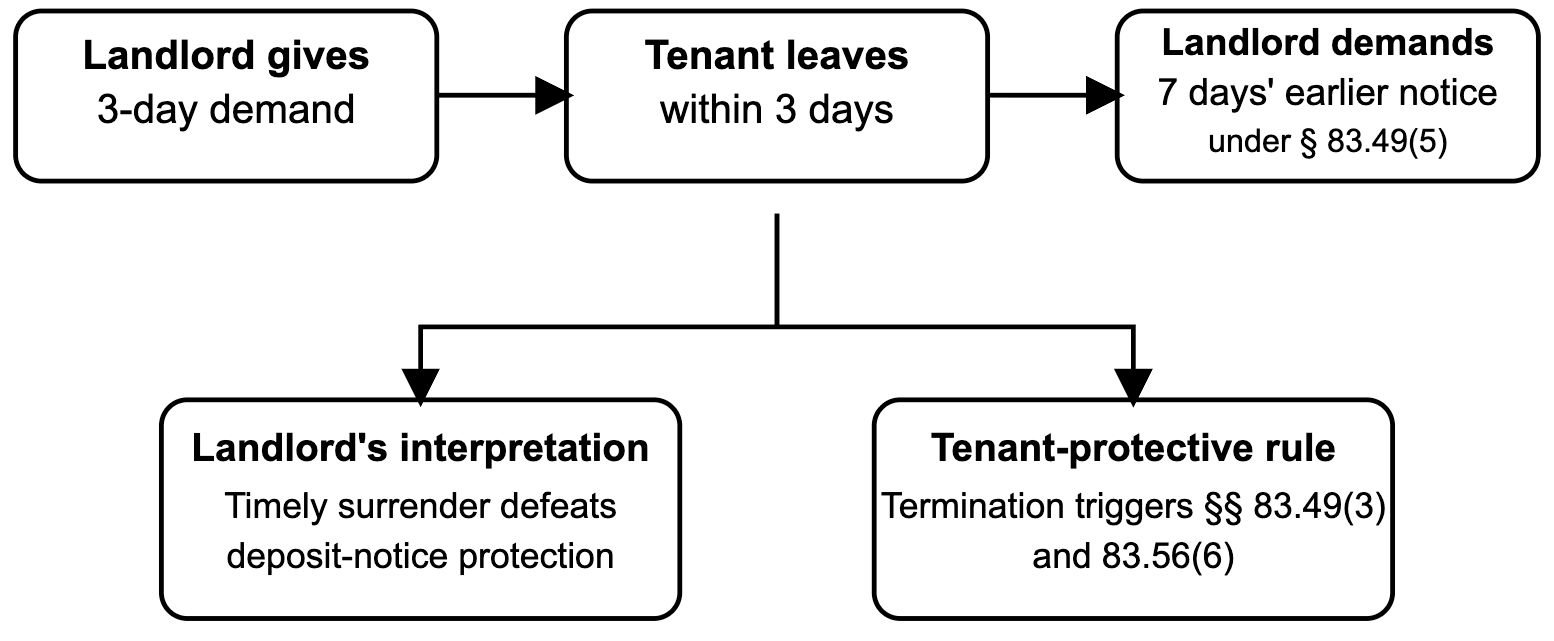
A landlord should not be able to demand possession in three days and then fault the tenant for failing to announce the departure seven days earlier.
On this page
- What Florida law requires after termination
- What section 83.49(5) actually says
- Why eviction creates a statutory conflict
- Where the landlord must send the notice
- Why eviction does not forfeit the deposit
- What the Florida cases do—and do not—decide
- Practical steps for tenants
- The complete section 83.49(5) article series
- Frequently asked questions
What Florida law requires after a rental agreement is terminated
Florida's residential security-deposit law separates the landlord's underlying damages claim from the landlord's right to take money from the deposit. A landlord may believe the tenant owes rent or caused damage. That belief does not eliminate the statutory procedure governing the protected fund.
Section 83.56(6) supplies the starting point: “If the rental agreement is terminated, the landlord shall comply with s. 83.49(3).” That command applies when the landlord uses Chapter 83 to terminate the tenancy. The landlord cannot treat eviction as both the end of the lease and an exemption from the procedure that Florida law attaches to termination.
If the landlord makes no claim
Under the current version of section 83.49(3)(a), a landlord who does not intend to impose a claim generally must return the security deposit, together with any required interest, within 15 days after termination of the rental agreement.
If the landlord intends to claim the deposit
A landlord intending to keep any portion must provide the tenant written notice within 30 days after termination. The notice must substantially follow the statutory form, identify the amount and reason for the claim, and explain the tenant's right to object. The authorized delivery methods are certified mail to the tenant's last known mailing address or qualifying e-mail under section 83.505.
If the landlord sends no timely claim notice
Section 83.49(3)(a) states that the landlord forfeits the right to impose a claim on the deposit and may not seek a setoff against it. The landlord may return the deposit and later file a separate damages action. Florida law therefore protects the deposit procedure without erasing a legitimate claim the landlord can prove in court.
What section 83.49(5) actually says
Section 83.49(5) addresses a tenant who vacates or abandons before expiration of a fixed term, as well as a tenant leaving a week-to-week, month-to-month, quarter-to-quarter, or year-to-year tenancy. Unless the written rental agreement provides otherwise, the tenant must give at least seven days' written notice by certified mail or personal delivery before leaving. The notice must include an address where the tenant may be reached.
Failure to provide that notice may relieve the landlord of the claim-notice requirement in subsection (3)(a). But the statute includes an important savings clause: the failure “does not waive any right the tenant may have to the security deposit or any part of it.” Even when subsection (5) applies, the landlord does not automatically own the money.
The provision makes sense when a tenant unexpectedly leaves an ongoing tenancy. Advance notice tells the landlord when possession will change and where the tenant can be reached. The provision becomes unstable when the landlord initiated termination, demanded possession, or obtained an eviction judgment. In those cases, the landlord already knows the tenancy is ending.
Why eviction creates a three-day versus seven-day conflict
Section 83.56(3) permits a Florida landlord to demand rent or possession within three days, excluding weekends and court-observed holidays. A tenant who cannot pay may surrender within that deadline to avoid further litigation and expense.
A broad landlord interpretation of section 83.49(5) would then penalize the tenant for complying. The landlord would argue that because the tenant left before the original lease-end date, the tenant should have given seven days' advance notice. But the tenant cannot both surrender in three days and provide seven days' advance notice. In some cases, the tenant would have needed to send the seven-day letter before the landlord served the termination notice.
The better reading is based on who initiated the end of the tenancy. Section 83.49(5) governs a tenant's independent early departure or abandonment from an otherwise continuing tenancy. Sections 83.49(3) and 83.56(6) govern the deposit after landlord-initiated termination. That interpretation gives each provision meaningful work and avoids making compliance with an eviction demand the reason a tenant loses deposit-notice protection.
Read the complete analysis of Florida's three-day and seven-day notice conflict.
Where must the landlord send the claim after eviction?
Section 83.49(3)(a) does not say “new address” or “forwarding address.” It says “last known mailing address.” The phrase provides a destination even when the tenant has not supplied a new location.
Depending on the facts, the last known mailing address may be:
- An address the tenant provided directly to the landlord;
- An address communicated by the tenant's authorized attorney or agent;
- An address stated in a stipulation, amendment, or other accepted communication;
- Another address the landlord actually knows the tenant uses; or
- The leased premises when no later mailing address is known.
The absence of a forwarding address does not make mailing impossible. The landlord can send certified mail to the address actually known and retain proof of compliance. The postal service may forward the letter, the tenant may continue monitoring mail, or another authorized recipient may deliver it.
Tenants should still provide a forwarding address in writing. It increases the likelihood of actual receipt and prevents the landlord from manufacturing an address dispute. But the legal distinction is essential: a forwarding address changes where the duty must be performed; it does not create the duty.
Read why the landlord must mail the post-eviction claim even without an updated address.
Why eviction does not forfeit the tenant's security deposit
An eviction judgment generally decides possession. A separate damages judgment may determine unpaid rent or other losses. Neither judgment necessarily adjudicates ownership of the security deposit unless the pleadings placed the fund at issue and the judgment actually resolved it.
Florida law expressly contemplates that a landlord may possess a damages claim while losing access to the deposit. When the landlord misses the statutory notice, section 83.49(3)(a) requires return of the deposit before a separate damages action. In Durene v. Alcime, the Third District explained that an independent damages claim did not permit the landlord to use the deposit as a setoff after violating the notice procedure.
The rule is not an undeserved windfall. It preserves a protected-fund procedure while leaving the courthouse open for provable damages. A landlord should not be allowed to bypass notice simply because the tenant was evicted.
Read the complete guide explaining why eviction does not forfeit a Florida security deposit.
What the Florida cases do—and do not—decide
Plakhov v. Serova
Plakhov involved tenants leaving a month-to-month tenancy without the notice required by subsection (5). It confirms that a tenant may lose the procedural benefit of the landlord's claim notice while retaining the substantive right to the deposit. It does not squarely decide whether subsection (5) applies when the landlord first terminated the rental agreement or evicted the tenant.
Pierre Woodland Meadows, LLC v. KAC 2021-1 LLC
Pierre Woodland arose from a venue dispute and examined whether an address filing effectively changed the tenant's mailing address. The decision is important for how an address update reaches the landlord. It should not be expanded into a categorical holding that every evicted tenant must provide seven days' advance notice.
Motif Apartments LLC v. Tenant's First, LLC
An initial Motif Apartments opinion referred to subsection (5). The later reported opinion omitted that language and resolved venue through the locations associated with the property, lease, notices, payments, and accrual of the claim. The final decision does not establish that subsection (5) controlled after landlord-initiated termination.
The reported appellate cases provide pieces of the analysis, but no final Florida appellate holding squarely resolves the three-day/seven-day conflict after landlord-initiated eviction. That is why careful treatment of the statutory structure matters.
What Florida tenants should do after receiving an eviction notice
The legal position that a landlord must mail the claim after termination does not eliminate the need for careful documentation. A tenant should:
- Preserve the lease and deposit proof. Keep the signed lease, receipt, canceled check, ledger, and deposit disclosures.
- Keep every termination and court document. Save the three-day or seven-day notice, complaint, judgment, and writ of possession.
- Provide a forwarding address. Send it by certified mail or personal delivery and keep proof, while stating that departure is in response to the landlord's termination.
- Document surrender. Record the date keys were returned or the writ was executed.
- Photograph the unit. Take dated photographs and video of every room, surface, appliance, and key return.
- Watch the deposit deadlines. Preserve every envelope, postmark, certified-mail record, and authorized e-mail.
- Object promptly. If a claim notice arrives and the tenant disputes it, respond in writing within the applicable statutory period.
Statutory wording and timing have changed. The version governing a particular tenancy may depend on when the rental agreement terminated. Tenants should obtain advice about their specific facts before acting.
The Florida section 83.49(5) article series
This page is the central guide for Korte & Associates' ten-part examination of Florida security-deposit notice after eviction. Each installment addresses a distinct statutory or practical question.
- Seven Days Before Leaving: The Hidden Notice Trap in Florida's Security-Deposit Statute
- Florida's Three-Day Eviction Notice Cannot Require Seven Days' Move-Out Notice
- Section 83.56(6): Florida's Overlooked Post-Eviction Security-Deposit Command
- Eviction Does Not Forfeit a Florida Tenant's Security Deposit
- Why Plakhov v. Serova Does Not Decide the Evicted-Tenant Question
- What Pierre Woodland Actually Says About a Tenant's Last Known Address
- Why the Changed Motif Apartments Opinion Matters
- What “Vacates or Abandons” Means Under Section 83.49(5)
- Can a Florida Landlord Use an Eviction Judgment as a Security-Deposit Setoff?
- How the Florida Legislature Should Fix Section 83.49(5)
Frequently Asked Questions
Does a Florida tenant automatically lose the security deposit after eviction?
No. Eviction determines possession; it does not automatically transfer the deposit to the landlord. The landlord must comply with the applicable security-deposit procedure and prove entitlement to any deduction.
Must a landlord send a deposit claim notice after evicting a tenant?
Korte & Associates' position is yes. Section 83.56(6) requires the landlord to comply with section 83.49(3) when the rental agreement is terminated. A landlord intending to claim the deposit must timely provide the statutory notice.
What if the evicted tenant did not provide a forwarding address?
The landlord must use the tenant's last known mailing address. When no newer address is known, that may be the leased premises. A forwarding address is advisable, but it does not create the landlord's post-termination duty.
Does section 83.49(5) mean the landlord automatically keeps the deposit?
No. Even when subsection (5) applies, it expressly preserves the tenant's substantive right to the deposit. The provision may affect the landlord's notice duty, but it does not award ownership of the money.
How can a tenant give a forwarding address safely?
Provide it in a dated writing delivered by certified mail or personal delivery to the landlord or authorized agent. Identify the rental property, expected surrender date, and address where deposit communications should be sent. Keep a complete copy and delivery proof.
Can a landlord keep the deposit because the tenant owes more money?
Not without following the applicable deposit procedure. A separate debt or damages claim does not necessarily preserve access to the protected deposit. A landlord who misses the statutory claim notice may have to return the deposit and pursue damages separately.
About this guide
Korte & Associates represents Florida tenants in residential landlord-tenant disputes. This guide presents a tenant-protective interpretation of Florida's security-deposit statutes and identifies an issue Florida's appellate courts have not squarely resolved in a final merits decision. It is general legal information, not advice about a particular matter. Statutes change, and outcomes depend on the governing statutory version, lease, notices, procedural history, and evidence.
Primary authorities
- Florida Statutes § 83.49
- Florida Statutes § 83.56
- Florida Statutes § 83.59
- Plakhov v. Serova, 126 So. 3d 1221 (Fla. 4th DCA 2012)
- Durene v. Alcime, 448 So. 2d 1208 (Fla. 3d DCA 1984)
- Wootton v. Iron Acquisitions, LLC, 338 So. 3d 425 (Fla. 2d DCA 2022)
- Pierre Woodland Meadows, LLC v. KAC 2021-1 LLC, 377 So. 3d 625 (Fla. 4th DCA 2024)
- Motif Apartments LLC v. Tenant's First, LLC, 418 So. 3d 200 (Fla. 4th DCA 2025)