
|
RESOURCES
Does
Florida Statute 83.49(5) Apply After an Eviction?
|
Does Florida Statute 83.49(5) Apply After an Eviction?
The statute tells some tenants to give seven days’ notice before leaving. A different provision says that once a rental agreement is terminated, the landlord shall follow the security-deposit accounting rules. When the landlord ended the tenancy, those commands should not be treated as if they say the same thing.
Our Position
Section 83.49(5) addresses a tenant’s decision to vacate or abandon an otherwise existing tenancy. When the landlord has already terminated the rental agreement and pursued possession, section 83.56(6) should control: the landlord must comply with section 83.49(3). This is a tenant-protective interpretation of an unresolved issue, not a statement that every Florida court has adopted it.
|
The dispute begins with two statutory commands
Florida’s security-deposit statute does not say that a deposit becomes the landlord’s money when an eviction is filed or possession changes hands. Section 83.49(1) requires the money to be held for the tenant’s benefit and prohibits its use until it is actually due. Section 83.49(3)(a) then supplies the ordinary end-of-tenancy procedure: if no claim will be made, the landlord must return the deposit within 15 days after termination of the rental agreement; if the landlord intends to claim against it, the landlord must provide written notice within 30 days.
That claim notice must be provided by certified mail to the tenant’s “last known mailing address,” or by email only when the parties have satisfied the voluntary electronic-notice procedure in section 83.505. If the landlord misses the 30-day claim-notice deadline, the statute says the landlord forfeits the right to impose a claim against the deposit and may not use the deposit as a setoff, although the landlord may pursue a separate damages action after returning the deposit.
Section 83.49(5)
Unless the written rental agreement provides otherwise, a tenant who vacates or abandons before the stated term expires—or leaves a periodic tenancy—must give at least seven days’ written notice by certified mail or personal delivery and include an address where the tenant may be reached.
If that rule applies and the tenant does not comply, the landlord is relieved of section 83.49(3)(a)’s claim-notice requirement. The tenant’s substantive right to the deposit is expressly preserved.
Section 83.56(6)
This provision is shorter and categorical: “If the rental agreement is terminated, the landlord shall comply with s. 83.49(3).”
It does not say “unless the tenant failed to provide seven days’ notice.” Nor does it distinguish between termination for nonpayment, termination for another alleged breach, or termination followed by a judgment for possession.
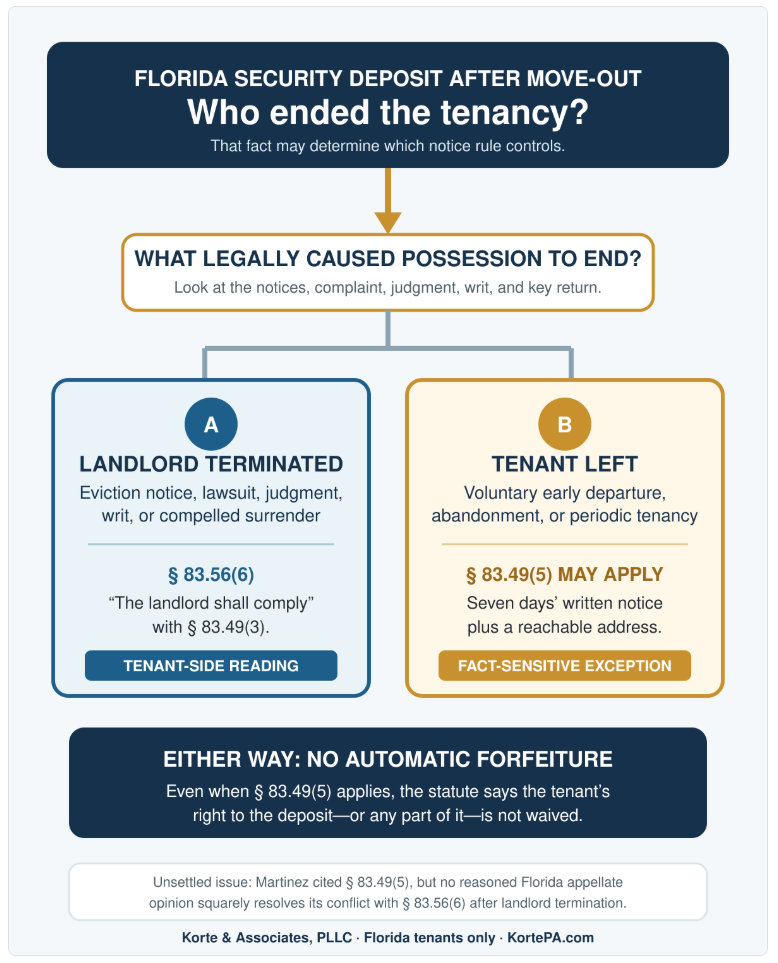
The key factual question is not merely whether the tenant physically left. It is who legally ended the tenancy and why possession changed.
Why “termination” and “vacating or abandoning” should not be collapsed
Words in related statutes should be read together, and different words ordinarily do different work. Section 83.49(5) is framed around a tenant who “vacates or abandons” before the “expiration of the term specified” or during a periodic tenancy. Section 83.56 repeatedly describes circumstances in which either party may “terminate” a rental agreement. Its final subsection then commands the landlord to comply with section 83.49(3) when termination occurs.
The tenant-side reading gives each provision a field of operation. Subsection (5) addresses a tenant’s unilateral departure from a still-operative tenancy: the tenant leaves early, abandons, or ends a periodic occupancy without the required advance information. Section 83.56(6), by contrast, addresses an agreement that has been legally terminated—including by a landlord as the statutory predicate to recovering possession.
This distinction also avoids a practical contradiction. A landlord’s statutory three-day notice may demand rent or possession within three days. If the tenant complies by surrendering possession, it is impossible to provide subsection (5)’s seven days of advance notice before leaving. A landlord should not be permitted to demand possession on the shorter timetable and later argue that the tenant lost the benefit of the landlord’s claim-notice duty by obeying that demand.
The same logic is even stronger after a final judgment and writ of possession. Physical removal under court process is not ordinary abandonment. Treating it as voluntary noncompliance changes a protection for landlords surprised by a tenant’s departure into a windfall for the party that chose, controlled, and documented the termination.
The landlord’s strongest textual argument
A fair analysis must acknowledge the contrary reading. Section 83.49(5) uses broad language: “any tenant who vacates or abandons” before the specified term expires, and “any tenant” who leaves a periodic tenancy. It does not expressly say “voluntarily,” and a tenant who departs after receiving an eviction notice has physically vacated. A landlord may therefore argue that subsection (5)’s exception applies whenever those literal conditions are met, regardless of who initiated termination.
The landlord may also argue that subsection (5) is the more specific rule about tenants who leave before expiration or leave periodic tenancies, while section 83.56(6) is only a general cross-reference. Under that view, the two sections are harmonized by reading section 83.56(6) as requiring compliance with section 83.49(3) subject to subsection (5)’s express exception.
Those are serious arguments. The tenant response is that subsection (5) speaks of a term that remains capable of “expiration,” while an agreement already terminated by the landlord no longer has an unexpired contractual term to abandon. More importantly, reading the exception to override section 83.56(6) inserts an unstated qualification into the Legislature’s mandatory command and produces the three-day-versus-seven-day contradiction described above.
What the Florida appellate decisions do—and do not—resolve
Martinez v. Roads Point Townhomes
In Martinez v. Roads Point Townhomes, Inc., 386 So. 3d 1000 (Fla. 3d DCA 2024), the Third District issued a short per curiam affirmance citing sections 83.49(3)(a) and 83.49(5), Plakhov, and a prevailing-party decision. The opinion’s bracketed quotation identifies the tenant as month-to-month and recognizes that failure to provide subsection (5) notice relieves the landlord of the claim-notice requirement without extinguishing the tenant’s right to the deposit.
Martinez is adverse authority and should not be ignored. But its two-page opinion contains no factual analysis explaining who terminated the tenancy, whether an eviction judgment caused the departure, or how section 83.56(6) affected the result. It therefore supports application of subsection (5) to the month-to-month facts before that court; it does not supply a reasoned resolution of the precise statutory conflict presented when a landlord has terminated the agreement and compelled possession.
Plakhov v. Serova
In Plakhov v. Serova, 126 So. 3d 1221 (Fla. 4th DCA 2012), the Fourth District held that when both sides failed to follow the applicable statutory procedures, they remained free to litigate entitlement to the deposit without the procedural advantages created by compliance. That principle confirms something important for tenants: even when subsection (5) applies, missing the seven-day notice does not automatically award the deposit to the landlord.
Plakhov did not decide the distinct question whether subsection (5) governs after landlord-initiated termination. It should be read for the procedural consequence it actually addressed, not as a universal rule that every post-possession dispute is stripped of section 83.49(3)(a)’s notice protections.
Motif Apartments v. Tenant’s First
Motif Apartments LLC v. Tenant’s First, LLC, 418 So. 3d 200 (Fla. 4th DCA 2025), was a venue case, not a merits decision fixing entitlement to a deposit. The court’s initial June 2025 opinion referred to subsection (5). On clarification, the court withdrew that opinion and issued a substituted September 2025 opinion omitting subsection (5). The revised decision held the tenant’s address filing ineffectual because it was not mailed to the landlord at the lease-specified address, so the place of payment did not change.
The deletion matters, but it must be described cautiously. The revised opinion does not affirmatively hold that subsection (5) is inapplicable after eviction. It simply no longer relies on subsection (5).
Motif therefore does not resolve the merits issue either way.
What remains true under either interpretation
Even the landlord-favorable reading of subsection (5) does not create automatic forfeiture. The last sentence says the tenant’s failure “does not waive any right the tenant may have to the security deposit or any part of it.” The dispute changes from one controlled by the landlord’s procedural forfeiture to one in which the parties may litigate entitlement, proof of damages, unpaid rent, mitigation, and the condition of the premises.
Similarly, eviction does not prove damages. A judgment for possession answers who is entitled to occupy the property. Unless the court also adjudicated money damages and the deposit itself, the landlord still must prove any separate financial claim. A tenant may dispute inflated repair costs, ordinary wear and tear, unsupported cleaning charges, amounts already reduced to judgment, failure to mitigate, or double recovery.
Wootton v. Iron Acquisitions, LLC, 338 So. 3d 425 (Fla. 2d DCA 2022), reinforces the importance of strict compliance when section 83.49(3)(a) applies. There, the Second District rejected a deficient claim letter and held that the statutory requirements must be followed before a landlord may retain part of the deposit. The scope dispute under subsection (5) is therefore consequential: it determines whether the landlord receives the benefit of avoiding a procedure that Florida otherwise treats as strict.
Practical steps for a tenant after eviction
- Provide a forwarding address anyway. The tenant-side legal position is stronger when the tenant also acted reasonably. Send the address promptly and preserve proof. If the parties signed a valid section 83.505 addendum, email may be available; otherwise, certified mail and an additional trackable method create a better record.
- Save every termination document. Keep the three-day or seven-day notice, complaint, judgment, writ of possession, settlement, key-return receipt, and any message demanding surrender. They help establish that the landlord—not the tenant—ended the agreement.
- Calendar both statutory periods. Track 15 days after termination if no claim is asserted and 30 days for a claim notice. Record the postmark, transmission evidence, delivery, and the date you actually received anything.
- Object promptly to a claim notice. Section 83.49 gives the tenant 15 days after receipt to object. An objection should identify the disputed deductions and preserve all defenses. Do not assume the eviction case already resolved the deposit.
- Preserve the condition evidence. Photos, video, inspection reports, repair requests, invoices, and witnesses may decide the merits if a court concludes that subsection (5) relieved the landlord of the claim-notice procedure.
- Get legal advice before sending a broad demand. The date of termination, type of tenancy, wording of the eviction papers, lease notice provisions, electronic-notice addendum, and prior judgment can change the analysis.
The better reading protects the statute’s design
Section 83.49(5) protects a landlord who may not know that a tenant has left or where the tenant can be reached. That purpose does not fit a landlord who served the termination notice, filed the eviction, obtained possession, and knows the tenancy has ended. In that setting, requiring the ordinary deposit accounting is neither unfair nor impractical. The landlord has the records, controls the deposit, knows the termination date, and can send notice to the tenant’s last known mailing address or use a valid section 83.505 email channel.
The competing interpretation would let a landlord create the termination and then use the tenant’s compliance with it to eliminate the very notice duty that section 83.56(6) says follows termination. Florida’s appellate courts have not yet squarely resolved that conflict in a reasoned merits opinion. Until they do, tenants and their counsel should preserve the issue, distinguish voluntary abandonment from landlord-initiated termination, and insist that subsection (5)’s express preservation of deposit rights be given real effect.
Frequently Asked Questions
Does an eviction automatically forfeit a Florida tenant’s security deposit?
No. Even section 83.49(5) says that failure to provide its notice does not waive the tenant’s right to the deposit or any portion of it.
What must the landlord ordinarily do after termination?
Under section 83.49(3)(a), the landlord ordinarily must return the deposit within 15 days if no claim is intended or provide a written claim notice within 30 days. The subsection (5) dispute concerns whether the landlord is relieved of the claim-notice requirement in a particular case.
Can the landlord now email the claim notice?
Only in accordance with section 83.505. That statute requires a voluntary, signed electronic-notice addendum with designated email addresses. A notice sent under that procedure is deemed delivered when sent unless returned as undeliverable.
Should a tenant who was evicted still send a forwarding address?
Yes. It reduces factual disputes and provides an alternative basis for challenging a misdirected claim notice. Preserve the letter, transmission record, tracking, emails, texts, and any acknowledgment.
What if the court says subsection (5) applies?
The tenant does not automatically lose the deposit. The parties may still litigate who is entitled to it, and the landlord must prove any claimed deductions or damages.
Related KortePA resources
- Florida Evictions and Security Deposits: Complete Section 83.49(5) Guide (series pillar page)
- What Happens to a Florida Tenant’s Security Deposit After Eviction? (Week 1 companion article)
- Florida Security Deposit Guide for Tenants
- Security Deposit Recovery
Authorities
- Fla. Stat. § 83.49 (2026)
- Fla. Stat. § 83.56 (2026)
- Fla. Stat. § 83.505 (2026)
- Martinez v. Roads Point Townhomes, Inc., 386 So. 3d 1000 (Fla. 3d DCA 2024)
- Plakhov v. Serova, 126 So. 3d 1221 (Fla. 4th DCA 2012)
- Motif Apartments LLC v. Tenant’s First, LLC, 418 So. 3d 200 (Fla. 4th DCA 2025)
- Wootton v. Iron Acquisitions, LLC
- , 338 So. 3d 425 (Fla. 2d DCA 2022)
Editorial and legal-information disclosure: This article is part of a tenant-focused statutory-analysis series prepared by Korte & Associates. It advocates a tenant-protective interpretation of an unsettled issue and identifies contrary authority. It provides general legal information, not advice for a particular case. Statutes, procedural rules, lease terms, termination documents, and later court decisions may change the analysis.