
|
RESOURCES
Can a Florida Lease Override a Tenant's Security-Deposit Rights?
|
Can a Florida Lease Override a Tenant's Security-Deposit Rights?
A lease matters, but it does not outrank Florida's Residential Landlord and Tenant Act. The real question is whether the contract fills a gap the statute leaves open or tries to erase a right, remedy, requirement, or legal liability that the Legislature imposed.
Short Answer:
Section 83.47 makes a residential lease term void and unenforceable to the extent it purports to waive statutory rights, remedies, or requirements, or limit liability arising under law. But section 83.49(5) itself begins with an exception for what a written rental agreement otherwise provides. That narrow permission must be read carefully; it is not a license to convert every deposit into automatic liquidated damages or to erase the rest of section 83.49.
|
The lease and the statute do different jobs
A residential lease defines rent, term, permitted use, deposits, and many other obligations. Florida law supplies mandatory rules around that contract. Two provisions are central when a lease clause appears to decide the security deposit before the facts are known.
Section 83.47: the anti-waiver rule
A rental-agreement provision is void to the extent it purports to waive or preclude rights, remedies, or requirements in Part II of chapter 83, or to limit either party's liability arising under law. The invalid part can be separated from otherwise enforceable lease terms.
Section 83.49: the deposit procedure
Deposit money is held for the tenant's benefit until actually due. After termination, subsection (3) ordinarily requires return within 15 days if no claim is intended or a compliant claim notice within 30 days if the landlord intends to keep any portion.
The analysis is therefore not finished by finding a sentence in the lease. A court must identify what the money is, what the statute requires, whether the statute expressly permits contractual variation, and whether enforcing the clause would eliminate a statutory right or merely define a lawful underlying obligation.
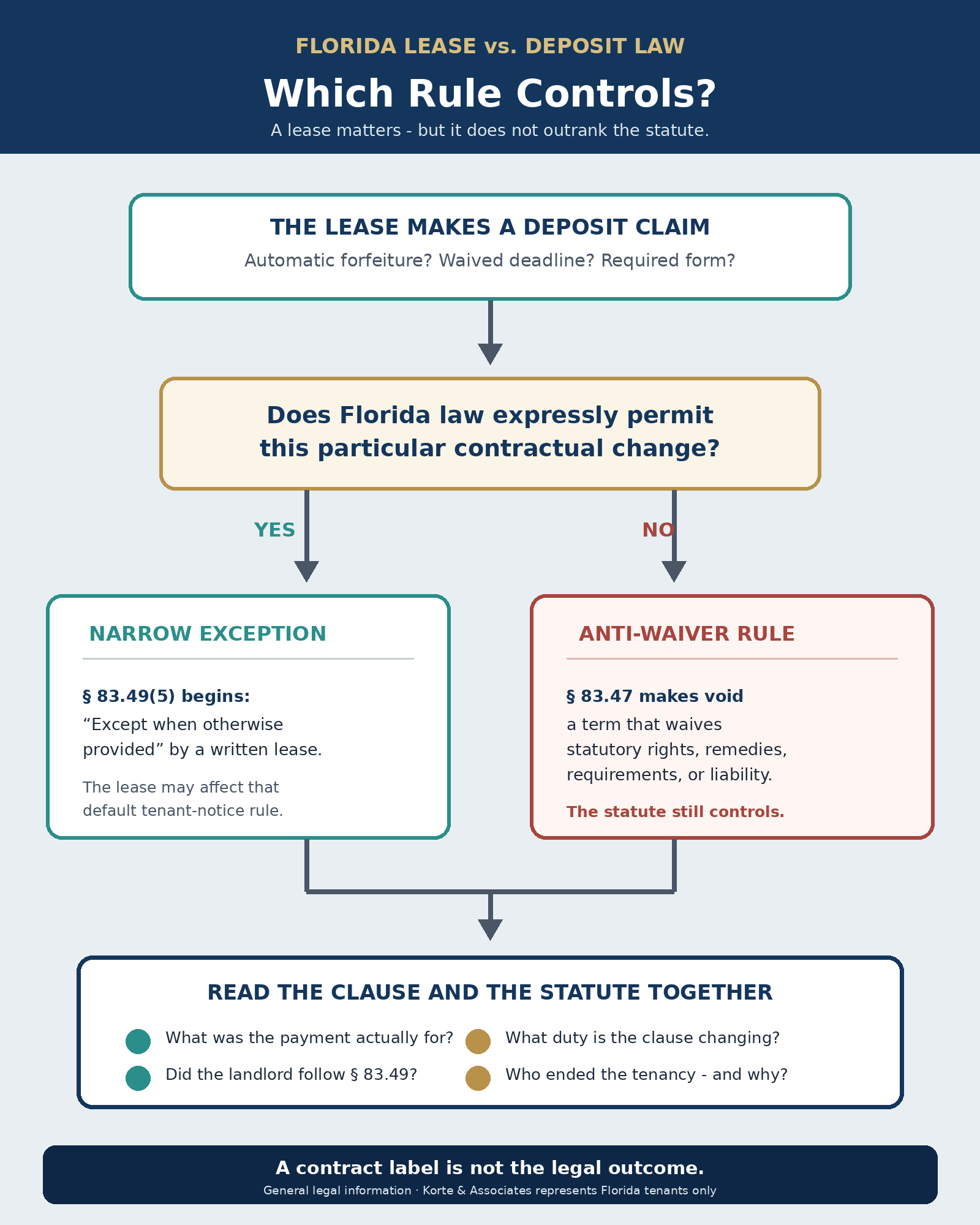
A lease can define obligations and, where the statute expressly allows it, alter a default rule. It cannot silently erase mandatory deposit protections.
Six common clauses require separate analysis
1. “The deposit is automatically forfeited after eviction or breach”
This language tries to turn the outcome of a possession dispute into ownership of a separate protected fund. Section 83.49 does not contain an eviction-forfeiture rule. It says the landlord may not use deposit money until it is actually due and creates a procedure for asserting a claim after termination.
A landlord may have legitimate claims for unpaid rent, physical damage, or another breach. That is not the same as automatic ownership of the entire deposit. The claim still must be legally recoverable, supported by evidence, and handled through any deposit procedure that applies. A possession judgment does not decide an unpleaded deposit dispute merely because the lease uses the word “forfeit.”
2. “The tenant waives the 15-day return and 30-day claim-notice rules”
A blanket prospective waiver collides directly with section 83.47. The return and claim-notice rules are statutory requirements, not merely optional lease promises. In Wootton v. Iron Acquisitions, LLC, 338 So. 3d 425 (Fla. 2d DCA 2022), the Second District required strict compliance with section 83.49 before the landlord could retain part of the deposit. A lease should not accomplish in advance what the statute forbids through noncompliance.
There is an important threshold qualification. If section 83.49(5) applies and a covered tenant failed to provide its required advance notice, the statute itself may relieve the landlord of subsection (3)(a)'s claim-notice duty. That result would arise from the statute, not from an unlimited lease waiver.
3. “The tenant must use our portal or designated form to update an address”
Using the lease channel is good practice because it reduces proof disputes. But section 83.49(3)(a) directs certified mail to the tenant's “last known mailing address.” Korte & Associates' tenant-side position is that the phrase establishes a knowledge standard: the controlling address is the correct mailing address actually known to the landlord, regardless of whether the landlord learned it through a form, correspondence, pleadings delivered to the landlord or counsel, payment records, texts, emails, prior mailings, management records, testimony, or an admission.
A lease should not be used to make known facts legally invisible. The issue is fact-sensitive, and no reported Florida appellate decision appears to have squarely announced the full knowledge-based rule in the post-eviction setting. Tenants should therefore comply with a workable lease channel when possible while preserving every other record that proves actual knowledge. Read the complete address analysis in What “Last Known Mailing Address” Means Under Florida Security-Deposit Law.
4. “Any email, text, portal post, or ordinary letter is sufficient notice”
For a landlord's statutory deposit claim, section 83.49(3)(a) specifies certified mail to the last known mailing address or email in accordance with section 83.505. Section 83.505 requires a voluntary, conspicuous addendum and designated email addresses. A general lease clause saying that routine communications may be electronic is not necessarily the statutory addendum.
The reverse problem also matters. A lease cannot sensibly require certified-mail proof of every fact by which the landlord learned a tenant's address. The certified-mail language in subsection (3)(a) governs how the landlord sends the claim notice. It does not say that landlord knowledge can arise only from a certified address-update letter.
5. “Returned or unclaimed mail ends the tenant's rights”
Section 83.49(3)(a) focuses on the landlord's timely act of sending the notice by the authorized method to the correct statutory destination. It does not make actual receipt a universal prerequisite to an effective certified mailing. But that does not excuse a landlord who selected an obsolete address despite knowing the correct one.
Landlord-created delivery failures deserve separate attention. An incorrect or obsolete landlord address can frustrate the tenant's forwarding letter or objection. Certified mail may be refused or left unclaimed. A property-management change may send records and mail into a dead channel. Those facts do not produce one automatic rule, but they matter to knowledge, good faith, credibility, and whether a party can fairly rely on a failed delivery it helped create. Save the envelope, postal tracking, screenshots, notices of management change, and evidence identifying the address actually used by the parties.
6. “No seven-day move-out notice means the landlord keeps the deposit”
This overstates section 83.49(5). The subsection says that, unless the written rental agreement otherwise provides, certain tenants must give at least seven days' written notice by certified mail or personal delivery before vacating or abandoning, including an address where the tenant may be reached. If the subsection applies and the tenant does not comply, the landlord is relieved of subsection (3)(a)'s notice requirement. The very next clause says the tenant does not waive any right to the deposit or any part of it.
Plakhov v. Serova, 126 So. 3d 1221 (Fla. 4th DCA 2012), and
Martinez v. Roads Point Townhomes, Inc., 395 So. 3d 667 (Fla. 3d DCA 2024), recognize that procedural consequence on the records before them. They do not transform the deposit into a contractual penalty.
What “except when otherwise provided” permits - and what it does not
The opening words of subsection (5) must be given effect. A written lease may “otherwise provide” regarding the tenant's advance notice obligation. Depending on the language, the lease might waive the seven-day requirement, replace it with another agreed procedure, or coordinate it with a longer lease notice. That is a stronger contractual argument than a clause that attempts to waive subsection (3)'s landlord duties, because subsection (5) itself expressly invites the lease to address its default.
But the exception belongs to subsection (5). It should not be detached and used to rewrite subsection (1)'s custodial duties, subsection (3)'s return and claim procedure, subsection (3)(c)'s prevailing-party remedy, or subsection (5)'s own savings clause. Nor should a clause be treated as an enforceable early-termination charge unless it satisfies the requirements governing that remedy.
A “forfeiture” clause is not automatically a lawful early-termination fee
Section 83.595 authorizes a landlord to choose among remedies after a tenant's breach or early termination. One option is liquidated damages or an early-termination fee, but the statute imposes conditions: the amount may not exceed two months' rent, the parties must indicate acceptance when the rental agreement is made, and the tenant must sign a separate addendum containing the statutory election language substantially as provided.
A court may need to decide whether a disputed payment was truly a nonrefundable fee, a section 83.595 remedy, advance rent, or a refundable security deposit. Labels help describe the parties' agreement, but statutory substance controls. A landlord should not be able to take money collected as security, rename it only after the tenancy ends, and thereby avoid section 83.49.
Why landlord-initiated termination changes the subsection (5) analysis
Korte & Associates' tenant-side position is that subsection (5)'s formal tenant-notice rule applies only if subsection (5) governs the departure at all. It fits a tenant who independently vacates or abandons an otherwise continuing fixed-term or periodic tenancy. It should not govern after the landlord terminates the rental agreement and demands possession.
Section 83.56(6) states that if the rental agreement is terminated, the landlord shall comply with section 83.49(3). A nonpayment notice may demand rent or possession within three days. It is not sensible to permit a landlord to impose that shorter deadline and then rely on a lease clause or subsection (5) because the tenant did not give seven days' advance warning before obeying it. The full analysis appears in Does Florida Statute 83.49(5) Apply After an Eviction?.
This precise statutory interaction remains unsettled.
Martinez cited subsection (5) in a short affirmance involving a month-to-month tenant, but did not analyze section 83.56(6) or identify landlord-initiated eviction facts. Tenants should present the narrower reading as a reasoned statutory position, not a rule already adopted in every Florida court.
Lease notice clauses, address knowledge, and narrow venue decisions
Pierre Woodland Meadows, LLC v. KAC 2021-1 LLC, 377 So. 3d 625 (Fla. 4th DCA 2024), and the substituted opinion in Motif Apartments LLC v. Tenant's First, LLC, 418 So. 3d 200 (Fla. 4th DCA 2025), addressed venue records in which the asserted address change had not been effectively delivered to the landlord. Motif's substituted opinion omitted the original opinion's subsection (5) statement. These decisions should be read for their address-delivery and venue facts, not as replacing the Legislature's “last known mailing address” language with a universal formal-service requirement.
Once the landlord actually knows the tenant's correct updated mailing address, the tenant-side position is that both a claim notice and a return of the deposit are due there, regardless of the source of that knowledge. That destination may also bear on the place of payment in a small-claims action. A later installment will address Florida Small Claims Rule 7.060(a)(7) and venue directly; a plaintiff should not rely merely on an assignee's office location.
Evidence tenants should preserve
- The complete lease package. Save the lease, every renewal, addendum, deposit receipt, early-termination election, electronic-notice addendum, rules, and move-out instructions.
- Proof of what the payment was. Keep the ledger, canceled check, receipt, advertisement, application, and messages describing the money as refundable, security, advance rent, a fee, or liquidated damages.
- Termination and possession records. Preserve notices, the eviction complaint, judgment, writ, settlement, surrender agreement, key receipt, and communications demanding possession.
- Every address record. Keep correspondence, pleadings delivered to the landlord or counsel, payment records, texts, emails, prior mailings, property-management records, deposition or trial admissions, and anything showing the landlord used or acknowledged the correct address.
- Delivery evidence. Save certified-mail receipts, envelopes, tracking histories, refusal or nonclaim notations, returned mail, portal screenshots, email headers, and notices identifying old or new management.
- Merits evidence. Photographs, video, inspections, repair requests, invoices, estimates, payment histories, and witnesses remain important because invalidating an automatic-forfeiture clause does not prevent the landlord from proving a lawful underlying claim.
Frequently Asked Questions
Can a Florida lease say a security deposit is automatically forfeited after eviction?
A lease cannot simply erase statutory rights or requirements. The landlord may prove lawful rent or damage claims, but an eviction judgment for possession does not automatically transfer the deposit.
Can a lease waive Florida's 30-day security-deposit claim notice?
A blanket advance waiver conflicts with sections 83.47 and 83.49. Whether subsection (5) independently relieves the landlord of the duty is a separate threshold question.
May a lease change the seven-day tenant notice rule?
Potentially. Subsection (5) expressly begins with an exception for what a written rental agreement otherwise provides. The particular wording still cannot be expanded beyond that subsection or converted into automatic deposit forfeiture.
Can the lease force the landlord to use an address it knows is obsolete?
Korte & Associates' tenant-side position is no. “Last known mailing address” should turn on the correct address actually known to the landlord. The factual proof and the relevant lease language should both be preserved.
Does the landlord have to prove actual receipt of the certified claim letter?
Not as a universal rule. The statutory focus is timely certified mailing to the last known address. A knowingly misaddressed mailing, however, raises a different compliance issue.
What if the tenant did not send a seven-day letter after eviction?
The landlord may invoke subsection (5), but the tenant can argue it does not govern landlord-initiated termination. That issue remains unsettled, and subsection (5) preserves the tenant's substantive right to the deposit even when it applies.
Authoritative sources
- Fla. Stat. § 83.47 (2026) - prohibited lease provisions.
- Fla. Stat. § 83.49 (2026) - deposit custody, return, claims, and subsection (5).
- Fla. Stat. § 83.56(6) (2026) - compliance with subsection 83.49(3) after termination.
- Fla. Stat. § 83.505 (2026) - voluntary electronic delivery of notices.
- Fla. Stat. § 83.595 (2026) - remedies and early-termination addendum.
- Wootton v. Iron Acquisitions, LLC, 338 So. 3d 425 (Fla. 2d DCA 2022).
- Martinez v. Roads Point Townhomes, Inc., 395 So. 3d 667 (Fla. 3d DCA 2024).
Continue the series
- Florida Evictions and Security Deposits: The Complete Guide to Section 83.49(5)
- Does Florida Statute 83.49(5) Apply After an Eviction?
- What “Last Known Mailing Address” Means Under Florida Security-Deposit Law
- What Happens When a Landlord Misses the 30-Day Deposit Notice Deadline?
- Florida Security-Deposit Recovery for Tenants
Editorial and legal-information disclosure: This page provides general Florida legal information and presents identified tenant-side interpretations of unsettled questions. It is not legal advice for a particular matter and does not create an attorney-client relationship. The facts, lease language, procedural posture, and later authority may change the analysis. Korte & Associates represents Florida tenants exclusively.