
|
BLOG
News
GET THE LEGAL ASSISTANCE YOU REQUIRE AT THIS MOMENT
|
Can a Landlord Sue After Missing Florida's Deposit Deadline?
The certified letter never came. More than 30 days passed. Then the landlord said the security deposit was being applied to unpaid rent or repairs - and threatened to sue for even more.
Florida law treats that situation as two separate disputes. One concerns the protected security-deposit fund. The other concerns whatever contract or damage claim the landlord says exists. Missing the deposit deadline can decide the first issue without automatically deciding the second.
That distinction is important for tenants because a landlord should not be allowed to keep the deposit first and force the tenant to fight later when the statutory claim procedure was never followed.
The missed deadline usually means the deposit must be returned
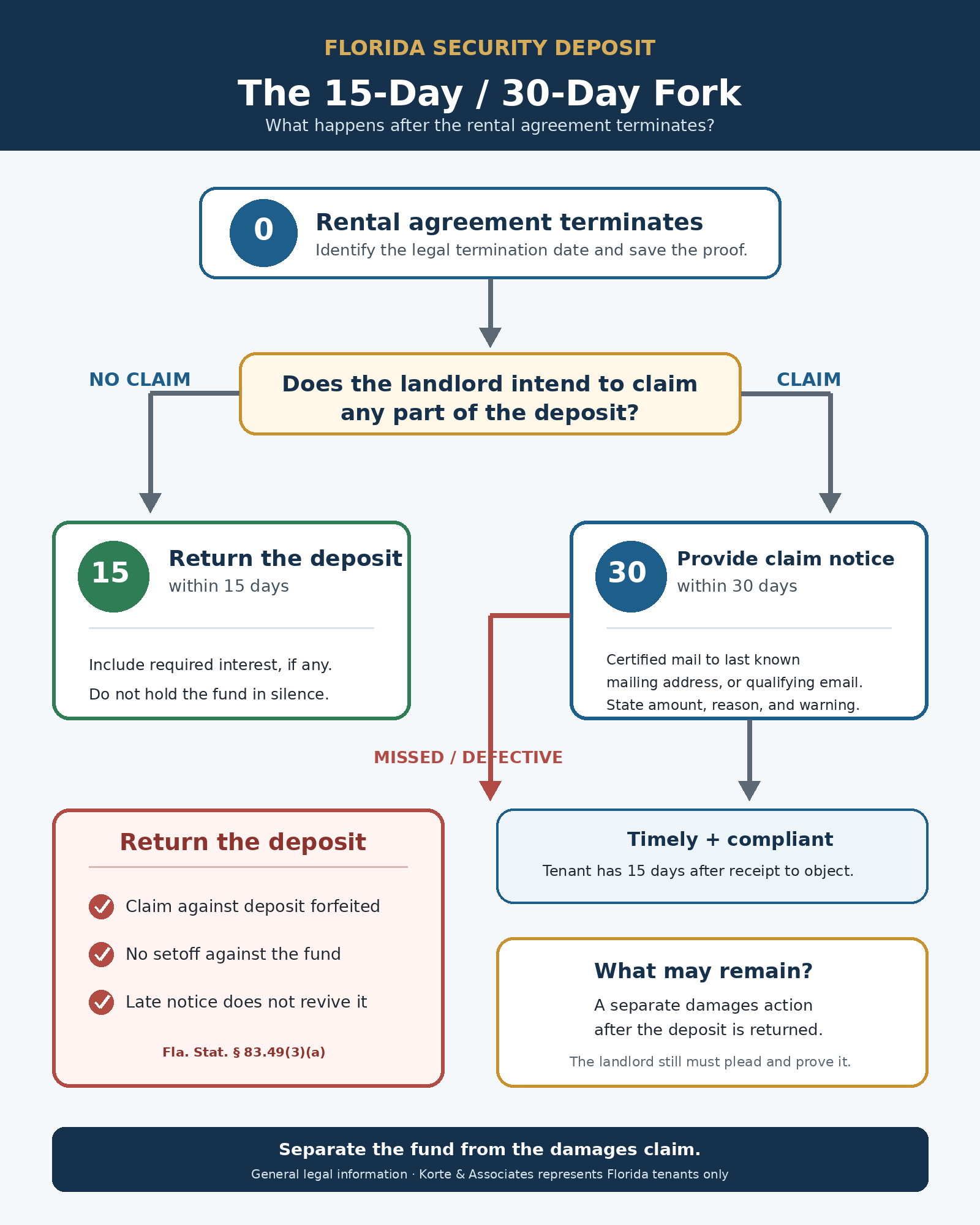
Under Florida Statute section 83.49(3)(a), a landlord who does not intend to claim the deposit generally must return it within 15 days after the rental agreement terminates. A landlord who does intend to claim must provide the statutory written notice within 30 days.
The current statute allows the claim notice to be sent by certified mail to the tenant's last known mailing address. Email works only when the landlord and tenant completed the voluntary electronic-notice process in section 83.505.
If the landlord was required to provide the notice but missed the 30-day period, the statute says the landlord forfeits the right to impose a claim on the deposit and may not seek a setoff against it. In plain language: the landlord must return the fund and cannot simply credit it against alleged damages.
Why the landlord may still file a separate lawsuit
The same statutory sentence that prohibits the deposit claim preserves a separate action for damages after the deposit is returned. That may sound contradictory, but it reflects a deliberate division.
The deadline protects the deposit as a readily available fund. It requires the landlord to make and communicate deductions promptly. If the landlord ignores that process, the landlord loses the shortcut of paying itself from money already in its hands.
The landlord's underlying claim is different. If the landlord believes rent remains unpaid or the tenant damaged the property, it can file a lawsuit, prove the claim, obtain a judgment, and use ordinary judgment-enforcement procedures. The landlord cannot treat its own allegation as proof, and it cannot use the deposit as automatic payment after forfeiting the right to do so.
The Third District explained this structure in Durene v. Alcime, 448 So. 2d 1208 (Fla. 3d DCA 1984). The landlord's separate damages claim remained possible, but the deposit was no longer available to the landlord or the court as a setoff.
A late notice does not restore the deposit claim
A claim letter sent after day 30 may show what the landlord alleges, but it does not make the letter timely. The statute ties forfeiture to failing to act within the required period.
Tenants should still keep a late letter. It may establish when the landlord first identified the deduction, reveal that the explanation changed, confirm that the landlord still controlled the money, or provide amounts and documents that can be tested in later litigation.
Tenants should also examine whether the notice was otherwise compliant. In Wootton v. Iron Acquisitions, LLC, 338 So. 3d 425 (Fla. 2d DCA 2022), the court required strict compliance with section 83.49. A timely envelope is not enough if the notice uses the wrong recipient, an address the landlord knows is obsolete, or omits the required warning.
What the landlord still has to prove
A separate lawsuit is not an automatic win. The landlord may need to prove:
- the lease terms and the amount actually due;
- that the claimed repairs were caused by the tenant rather than ordinary wear, age, or a landlord maintenance problem;
- the reliability and amount of invoices, estimates, photographs, and testimony;
- compliance with the applicable remedy and mitigation rules;
- credit for payments, concessions, insurance, and prior judgments; and
- that the requested award is not a double recovery.
The tenant can therefore raise two layers of defense: the landlord forfeited access to the deposit, and the alleged damages are unsupported or overstated.
The address and delivery evidence still matter
The 30-day notice must go to the tenant's last known mailing address. Korte & Associates' tenant-side position is that this is a knowledge standard. The controlling address is the correct mailing address actually known to the landlord, regardless of whether that knowledge came from a formal forwarding letter, correspondence, pleadings actually delivered to the landlord, payment records, texts, emails, prior mailings, management records, or an admission.
Tenants should not assume that a court filing alone proves the landlord knew the address. Pierre Woodland and Motif Apartments involved address information that had not been effectively delivered to the landlord. Their narrow lesson is to connect the updated address to actual knowledge, not that Florida law recognizes only one formal update method.
Preserve the envelope, certified-mail tracking, email records, management communications, and proof that the landlord previously used the new address. A mailing to the correct known address is different from a mailing to an obsolete address selected after the landlord already knew better.
What about section 83.49(5)?
Section 83.49(5) may relieve a landlord of the claim-notice requirement when a tenant covered by that subsection fails to give seven days' written notice before vacating. Plakhov and Martinez recognize that consequence on the records before those courts. Even then, subsection (5) expressly says the tenant's substantive right to the deposit is not waived.
Korte & Associates' position is that subsection (5) should not apply after landlord-initiated termination or eviction. Section 83.56(6) directs the landlord to comply with subsection (3) when the rental agreement is terminated, and a landlord should not demand possession in three days and then fault the tenant for failing to give seven days' advance notice. Florida appellate courts have not squarely resolved that precise conflict, so it remains an unsettled tenant-side argument.
Read the complete analysis in Does Florida Statute 83.49(5) Apply After an Eviction?.
A tenant's evidence checklist
Keep copies of:
- the lease, renewals, and proof of the deposit;
- the termination notice, judgment, writ, surrender agreement, and key receipt;
- every claim letter, returned envelope, tracking event, and email header;
- proof of the address the landlord actually knew;
- move-in and move-out photographs and video;
- invoices, estimates, ledgers, payment records, and collection notices; and
- messages showing a management change, wrong landlord address, refused mail, or changing explanation.
Do not agree that the deposit can simply be “credited” against damages before analyzing the statute. The word credit can disguise the setoff that section 83.49(3)(a) prohibits after forfeiture.
Bottom line
A Florida landlord who misses the 30-day security-deposit notice deadline may still sue for independent damages. But the landlord generally must return the deposit first, cannot use that protected fund as a setoff, and must prove the separate claim through ordinary litigation.
For the full authority and procedural analysis, read What Happens When a Florida Landlord Misses the 30-Day Security-Deposit Notice Deadline?. For the series overview, visit Florida Evictions and Security Deposits: The Complete Guide.
Korte & Associates represents Florida tenants exclusively. This is general legal information, not advice for a specific case.
Blog FAQs
Can my landlord keep the deposit and sue for the balance?
Not when the landlord was required to provide the section 83.49(3)(a) notice and forfeited the deposit claim by missing the deadline. The deposit must be returned, and any independent damages claim proceeds separately.
What if the landlord sent the claim letter on day 31?
The letter is late under the 30-day rule and does not revive the forfeited right to claim or set off the deposit. Save it because its contents may still matter as evidence.
Does the court automatically subtract my deposit from any damages award?
No. Durene holds that a forfeited deposit is unavailable to the landlord or court as a setoff. A separate claim must be adjudicated and any judgment enforced ordinarily.
Can I still challenge the landlord's repair charges?
Yes. The landlord must prove causation and amount. You may dispute ordinary wear, preexisting conditions, maintenance failures, unreliable estimates, lack of mitigation, improper rent calculations, and double recovery.
What if I was evicted and did not give seven days' notice?
The landlord may invoke section 83.49(5). Korte & Associates maintains that subsection (5) should not govern after landlord-initiated termination, but the exact conflict remains unsettled in Florida appellate law.
What should I do if the landlord used my old address?
Preserve proof that the landlord actually knew the correct new address, including correspondence, pleadings delivered to counsel, payment records, texts, emails, prior mailings, management records, admissions, and tracking.
Find out if you have legal defenses in 2 minutes — take our free case evaluation at kortepa.com/free-case-evaluation