
|
BLOG
News
GET THE LEGAL ASSISTANCE YOU REQUIRE AT THIS MOMENT
|
I Was Evicted in Florida. Did I Lose My Security Deposit?
This is a subtitle for your new post
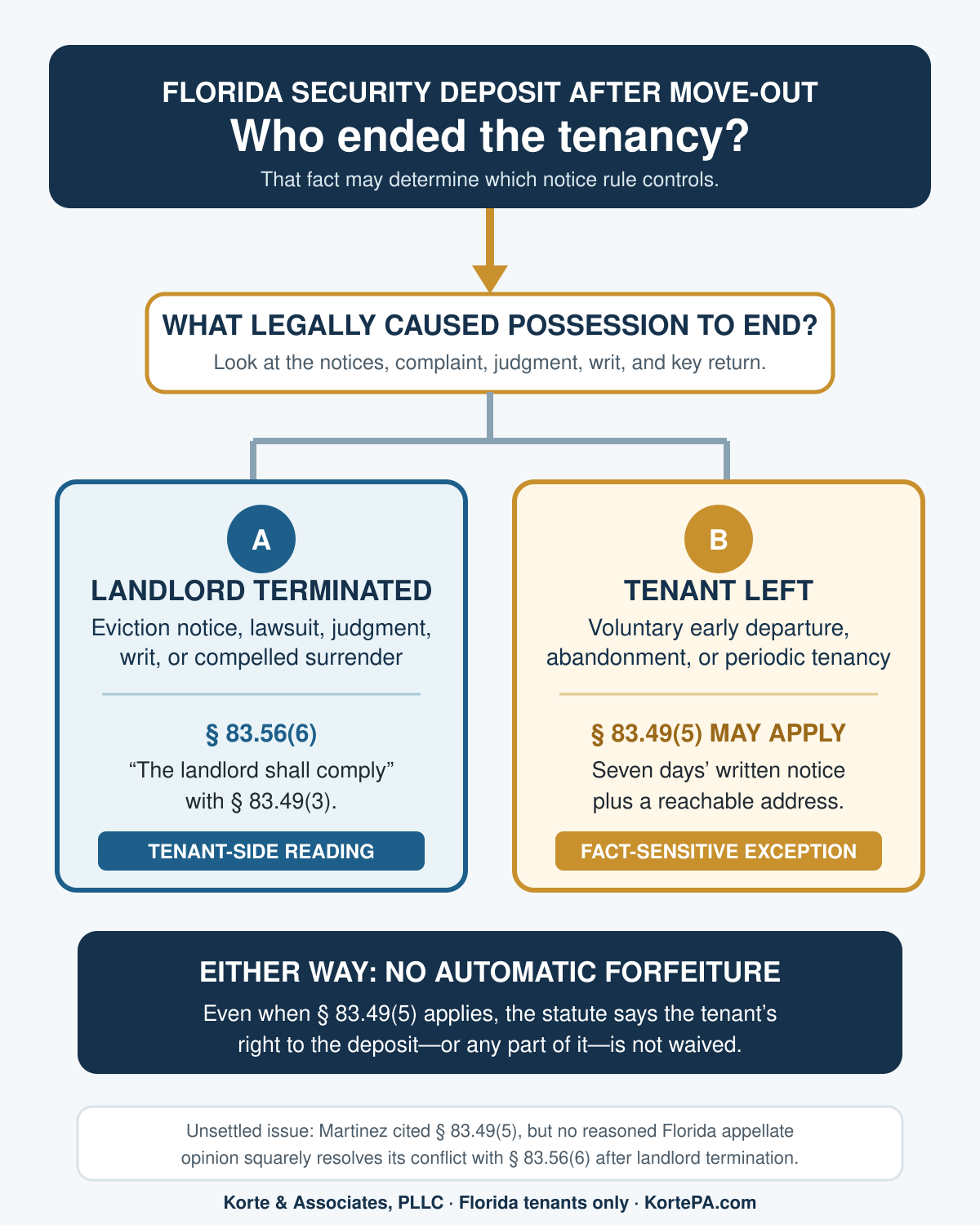
Being evicted from a Florida rental is not the same thing as forfeiting your security deposit. A judgment for possession decides who has the right to occupy the property. It does not automatically decide that the landlord owns the deposit, prove every claimed dollar of damage, or eliminate the procedures in Florida Statute section 83.49.
That distinction is easy to miss because landlords often treat the security deposit as an automatic credit against unpaid rent or move-out charges. Florida law is more demanding. The deposit begins as money held for the tenant’s benefit. The landlord may ultimately prove a valid claim, but possession alone does not perform that accounting.
Start with the ordinary 15-day and 30-day rules
When a rental agreement ends, section 83.49(3)(a) normally gives the landlord two paths. If the landlord does not intend to claim against the deposit, the deposit must be returned within 15 days after termination. If the landlord intends to impose a claim, the landlord must provide written notice within 30 days.
The 2026 statute permits that claim notice by certified mail to the tenant’s last known mailing address or by email only if the parties established electronic delivery through the voluntary addendum required by section 83.505. An ordinary email address appearing somewhere in the file is not necessarily the same thing as a statutory electronic-notice election.
The disputed seven-day rule does not erase the deposit
Section 83.49(5) says that certain tenants who vacate or abandon before the lease term expires—or leave a periodic tenancy—must provide at least seven days’ written notice before leaving and include an address where they may be reached. The prescribed methods are certified mail or personal delivery unless the lease provides otherwise.
If that subsection applies and the tenant did not comply, the landlord is relieved of section 83.49(3)(a)’s claim-notice requirement. But the statute immediately adds that the failure does not waive the tenant’s right to the deposit or any part of it.
That last sentence matters. At worst for the tenant, the dispute may proceed without the procedural advantage created by the landlord’s missed claim-notice deadline. The landlord must still prove entitlement to the money. The tenant may still contest unpaid-rent calculations, repair charges, ordinary wear and tear, cleaning costs, mitigation, and double recovery.
Why eviction creates a separate legal argument
Florida Statute section 83.56(6) says: “If the rental agreement is terminated, the landlord shall comply with s. 83.49(3).” Our tenant-side position is that this command applies when the landlord terminated the agreement and pursued possession. Section 83.49(5), on this reading, addresses the different situation in which a tenant unexpectedly leaves an otherwise existing tenancy.
The practical reason is powerful. A landlord may serve a three-day notice demanding rent or possession. A tenant who surrenders within that period cannot also give seven days of advance notice before leaving. The landlord should not be able to demand possession in three days and then use the tenant’s compliance as the reason to avoid the deposit claim-notice duty.
Florida appellate law has not cleanly resolved that exact conflict. In Martinez v. Roads Point Townhomes, the Third District cited subsection (5) in a short affirmance involving a month-to-month tenant. The opinion did not analyze section 83.56(6) or explain whether landlord-initiated termination controlled the departure. In Plakhov v. Serova, the Fourth District explained that when statutory procedures are not followed, the parties may litigate entitlement to the deposit. Neither decision says an eviction automatically gives the deposit to the landlord.
What to save immediately after an eviction
Preserve the documents that show why and when the tenancy ended:
The landlord’s three-day or seven-day notice.
The eviction complaint and summons.
Any settlement or move-out agreement.
The final judgment and writ of possession.
Proof of the date you returned keys or surrendered possession.
Photos and video of the unit at move-out.
The lease, payment ledger, receipts, and repair communications.
Any claim notice, envelope, postmark, email, or delivery record.
Proof that the landlord knew your forwarding address.
The termination date matters because it starts the ordinary section 83.49 deadlines. The reason for termination matters because it bears on whether subsection (5) should apply at all.
Give a forwarding address even if you dispute subsection (5)
A tenant should still provide a reliable forwarding address as soon as possible. Doing so does not concede that subsection (5) applies. It reduces factual disputes, gives the landlord a place to send the deposit, and makes it harder to defend a claim notice sent somewhere else.
Preserve the letter and every transmission record. Certified mail is useful, but also consider a second trackable method and any valid section 83.505 email channel. What matters in later litigation is the evidence, not merely the tenant’s recollection that “the landlord knew.”
An eviction judgment may not resolve money damages
Read the judgment carefully. A possession-only judgment is not necessarily a money judgment, and a money judgment for rent is not necessarily an adjudication of every claimed deduction from the security deposit. A landlord should not collect the same loss twice—once through a judgment and again through the deposit.
If the landlord included the deposit in the eviction accounting, determine whether the court actually adjudicated entitlement to it, whether the tenant had notice and an opportunity to dispute the issue, and whether the final judgment expressly granted a credit. Those questions can materially change the next step.
Bottom line
Eviction ends possession; it does not automatically transfer ownership of the deposit. Section 83.49(5) creates a real procedural dispute, but it expressly preserves the tenant’s underlying rights. When the landlord terminated the rental agreement, section 83.56(6) supplies a substantial tenant-side argument that the ordinary deposit procedure still applies.
For the complete statutory analysis, including the adverse cases, read Does Florida Statute 83.49(5) Apply After an Eviction? (https://www.kortepa.com/resources/does-83-49-5-apply-after-eviction). For the series overview, visit Florida Evictions and Security Deposits: The Complete Guide (https://www.kortepa.com/resources/security-deposit-after-eviction-florida).
Korte & Associates represents Florida tenants exclusively. If a landlord kept your deposit after an eviction, contact the firm at (561) 228-6200 for an evaluation.
Blog FAQs
Does an eviction judgment give the landlord my security deposit?
Not automatically. Review whether the judgment actually adjudicated money damages or the deposit. A judgment for possession alone determines occupancy, not necessarily ownership of the deposit.
What happens if I did not provide seven days’ notice before leaving?
If section 83.49(5) applies, the landlord may be relieved of the statutory claim-notice requirement. The statute nevertheless says your right to the deposit is not waived, so the parties may still litigate entitlement.
How long does the landlord ordinarily have after termination?
The ordinary rule is 15 days to return the deposit if no claim is intended, or 30 days to provide written notice of a claim. Whether subsection (5) excuses the claim notice is a fact-sensitive and legally disputed question.
Can I send my forwarding address by email?
Do not rely on ordinary email alone. Section 83.505 permits statutory electronic delivery when the parties signed the required voluntary addendum and designated addresses. Use a provable written method and preserve the evidence.
Blog disclosure
This post provides general legal information from a tenant-focused perspective. It is not legal advice. The lease, type of tenancy, termination documents, judgment, statutory notice methods, and later legal authority may change the result.
Find out if you have legal defenses in 2 minutes — take our free case evaluation at kortepa.com/free-case-evaluation