
|
RESOURCES
Does a Florida Eviction Judgment Let the Landlord Keep the Security Deposit?
|
Does a Florida Eviction Judgment Let the Landlord Keep the Security Deposit?
By
Brian K. Korte, Esq. · Published September 30, 2026 · Substantively updated September 30, 2026
Short Answer:
An eviction judgment for possession does not automatically transfer the tenant's security deposit to the landlord. Florida's eviction statute authorizes an action to recover possession. Florida Statute section 83.49 separately regulates protected deposit money and tells the landlord when to return it, how to assert a claim against it, and what happens when a required claim notice is missed.
The exact judgment still matters. If the landlord pleaded a deposit setoff, the parties litigated it, and the final judgment expressly disposed of the deposit, ordinary rules governing final judgments and claim preclusion may control. A settlement may also resolve the deposit. But a possession judgment, a writ of possession, or a registry disbursement should not be silently enlarged into a deposit award that the court never made.
|
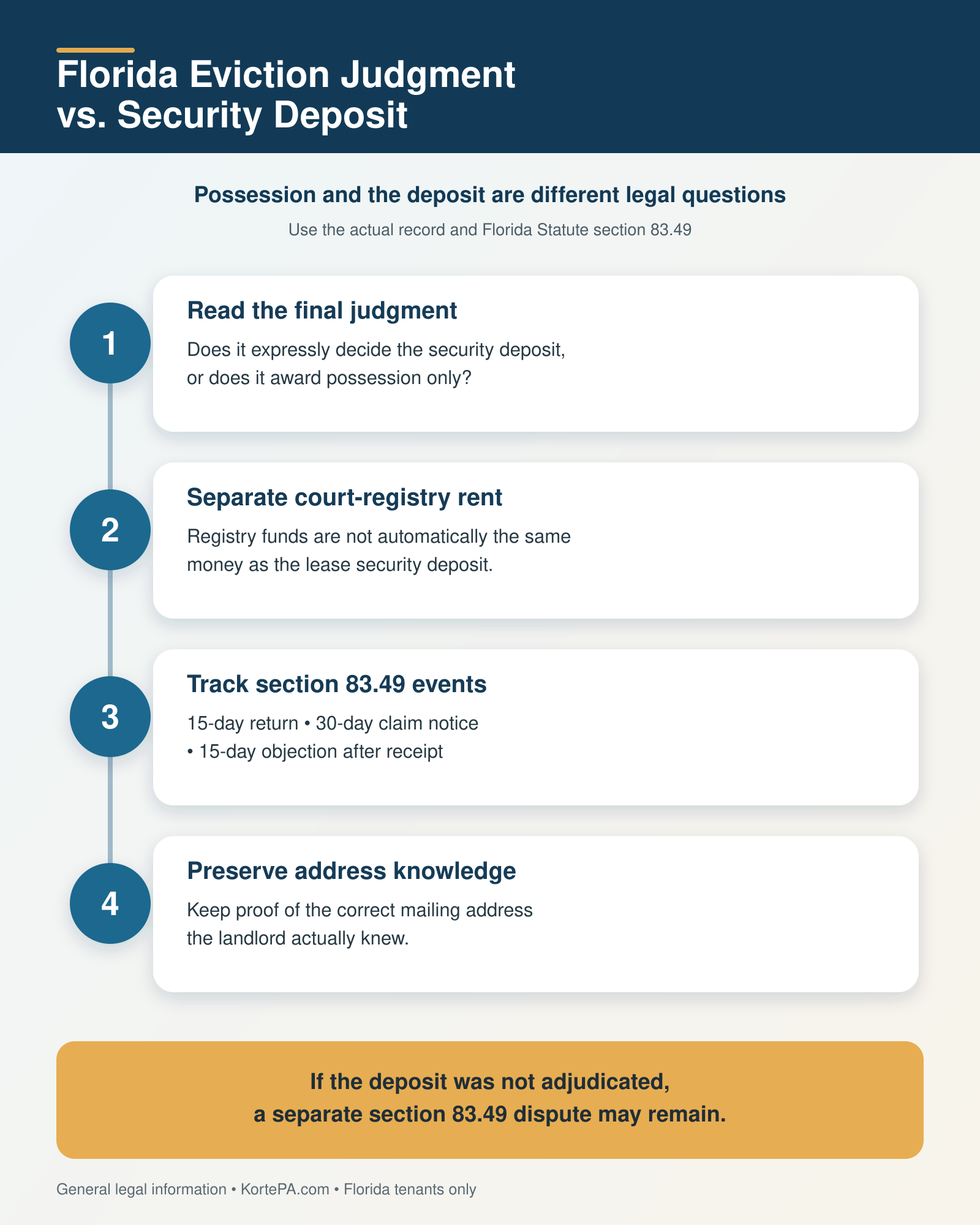
Possession and the security deposit are different legal questions
Section 83.59 is titled “Right of action for possession.” It allows a landlord to recover the dwelling unit after termination and describes the summary possession case. Section 83.49 addresses different property: money held for the tenant's benefit as security for performance of the rental agreement.
That separation is important after a fast eviction. The court may decide who has the present right to occupy the unit without deciding:
- whether the landlord timely sent a compliant deposit claim notice;
- whether each claimed deduction is chargeable against the deposit;
- whether the tenant gave notice under subsection 83.49(5);
- which mailing address the landlord actually knew;
- whether the deposit was pleaded and adjudicated; or
- whether the tenant or landlord prevailed on the deposit dispute.
Section 83.49(3)(c) itself contemplates an action to adjudicate a party's right to the security deposit. That language would do little work if every judgment for possession automatically decided the deposit without pleading, proof, or an express ruling.
Start with the actual pleadings, settlement, and judgment
Do not rely on the case caption or the fact that the landlord “won.” Obtain the full complaint, every amended pleading, the tenant's answer and counterclaims, motions, hearing notices, any settlement, the final judgment, the writ, the docket, and any transcript or recording that is available.
Then ask four separate questions:
- What relief did the landlord request? A complaint asking only for possession presents a different record from a complaint seeking possession, rent, physical damages, and a specific setoff against the deposit.
- What did the parties actually litigate? A deposit issue may be preserved, abandoned, settled, severed, or tried.
- What did the judgment expressly award? Look for language about possession, rent, other damages, the security deposit, court-registry money, costs, fees, and reservation of jurisdiction.
- Was the judgment by default, consent, settlement, or adjudication? Those procedural differences can materially affect later arguments about what was decided.
A tenant should not assume the deposit survived without reading the record. A landlord likewise should not assume a generic possession judgment adjudicated a deposit issue that was never presented.
Court-registry rent is not automatically the lease security deposit
Florida tenants defending a nonpayment eviction may be required to deposit accrued rent into the court registry under section 83.60(2). Those registry payments usually represent rent alleged or determined to be due during the case. The security deposit is the separate sum paid under the lease and held under section 83.49.
A final judgment may direct the clerk to disburse registry funds. That direction does not, without more, convert the lease deposit into registry rent or decide ownership of the separate deposit. Tenants should obtain the registry ledger and every disbursement order and compare them with the lease, payment receipt, and deposit ledger. The same dollar amount appearing in two places does not make the funds legally identical.
Landlord-initiated termination should trigger section 83.49(3)
Section 83.56(6) states that if the rental agreement is terminated, the landlord shall comply with section 83.49(3). Under subsection (3), the landlord generally must return the deposit within 15 days if no claim is intended, or provide the statutory claim notice within 30 days if a claim is intended.
Korte & Associates' tenant-side position is that this command applies when the landlord ends the tenancy and obtains possession. A landlord should not be allowed to use the eviction process to terminate the agreement and then treat that same termination as though the tenant independently abandoned an ongoing tenancy.
The interaction with subsection 83.49(5) remains unsettled. Subsection (5) speaks of a tenant who vacates or abandons before the expiration of the specified term, or leaves a periodic tenancy, and ordinarily requires at least seven days' advance written notice by certified mail or personal delivery. On its face, that provision fits a tenant-directed departure better than compliance with a landlord's termination demand or writ of possession. The complete argument appears in
Does Florida Statute 83.49(5) Apply After an Eviction?.
Even a subsection (5) failure does not automatically award the deposit
Subsection 83.49(5) expressly states that a notice failure “does not waive any right the tenant may have to the security deposit or any part of it.” Its stated consequence is procedural: if the subsection applies, the landlord is relieved of the ordinary paragraph (3)(a) notice requirement.
Plakhov v. Serova held that when both parties failed to comply with their respective statutory notice requirements, they remained free to litigate entitlement to the deposit without the usual procedural hurdles. The Third District's short decision in Martinez v. Roads Point Townhomes, Inc. cited the same rule and affirmed a result under subsections (3)(a) and (5). Neither decision says that the possession judgment itself transferred ownership of the deposit to the landlord.
This distinction prevents two different propositions from being collapsed into one. A tenant may lose the benefit of forcing the landlord through paragraph (3)(a)'s claim-notice procedure and still retain the substantive right to litigate who is entitled to the money.
A damages judgment and a deposit setoff are not always the same thing
Section 83.49(3)(a) draws an unusually clear line. A landlord who was required to provide the claim notice but failed to do so within 30 days forfeits the right to impose a claim on the deposit and may not seek a setoff against it. The landlord may still file a separate damages action—but only after returning the deposit.
That text means a landlord's possible claim for unpaid rent or physical damage does not automatically answer whether the landlord may take the same amount directly from the protected deposit. The landlord may have a damages theory and still lose the statutory setoff remedy. The tenant may recover the deposit and still have to defend an independent damages claim.
Wootton v. Iron Acquisitions, LLC reinforces the separation. The Second District required strict compliance with section 83.49 before the landlord could retain part of the deposit. The court rejected a letter that was not sent to the tenants' last known address and omitted required objection information.
Wootton did not treat the landlord's underlying repair allegations as a substitute for the statutory procedure.
The tenant's last known mailing address is a knowledge question
When paragraph 83.49(3)(a) applies, the landlord must send the claim notice by certified mail to the tenant's “last known mailing address,” or by qualifying email under section 83.505. Korte & Associates' tenant-side position is that this phrase imposes a knowledge standard: the controlling address is the tenant's correct mailing address actually known to the landlord, regardless of how the landlord learned it.
The statute does not say that knowledge counts only if the tenant used a landlord-created form, sent certified mail, addressed a particular office, used the lease notice channel, or obtained an acknowledgment. Once the landlord actually knows the correct updated address, the landlord should not be free to mail the deposit notice to an obsolete address and call that address “last known.”
Tenants should preserve correspondence, pleadings actually delivered to the landlord or counsel, payment records, checks, emails, texts, prior mailings, property-management records, resident ledgers, deposition or trial admissions, tracking documents, and any item showing what address the landlord knew and when.
The Fourth District's venue decisions in
Pierre Woodland Meadows and the substituted
Motif Apartments opinion involved address-delivery facts that affected the courts' venue analysis. They should be read on those records, not as replacing the Legislature's “last known mailing address” language with a universal formal-service requirement. A later installment will address Florida Small Claims Rule 7.060(a)(7)'s place-of-payment rule. This page does not rely merely on an assignee's office location.
When the prior judgment may control the deposit dispute
The deposit cannot be treated as automatically untouched in every case. A final judgment may expressly determine entitlement to the deposit. The parties may settle or stipulate to its treatment. A tenant may plead the deposit as a counterclaim, litigate it to judgment, and lose. A court may incorporate an agreed disposition. Those circumstances can trigger ordinary doctrines concerning finality, waiver, claim preclusion, or satisfaction.
The practical rule is narrow:
do not infer a deposit adjudication from possession alone, and do not ignore an express deposit adjudication that actually appears in the record. If the judgment is ambiguous, obtain the hearing record before acting. A later small-claims case is not the place to guess about what another court decided.
Build one post-eviction evidence file
A tenant evaluating the deposit after eviction should preserve:
- The complete eviction record: complaint, exhibits, service, answer, defenses, counterclaims, motions, settlement, judgment, writ, docket, and available transcript or recording.
- The money record: lease, addenda, deposit receipt, deposit disclosure, tenant ledger, rent ledger, court-registry ledger, disbursement orders, payment confirmations, and returned checks.
- The termination record: notices, move-out date, key return, surrender communications, sheriff activity, property turnover, and management acknowledgments.
- The address record: every document showing the tenant's correct mailing address and proof that the landlord, agent, or counsel actually knew it.
- The deposit-notice record: the landlord's letter, envelope, certified tracking, qualifying email evidence, the tenant's written objection, and proof of when each item was sent or received.
- The condition record: move-in and move-out photographs, video, inspections, repair requests, invoices, estimates, witnesses, and ordinary-wear evidence.
This file makes it possible to separate five disputes that are often blurred together: possession, rent, registry money, damages, and the deposit.
Frequently Asked Questions
Does losing a Florida eviction automatically mean the landlord gets the security deposit?
No. A possession judgment decides possession unless the deposit was also pleaded, litigated, settled, or expressly adjudicated. Section 83.49 separately controls claims against the deposit.
Is rent deposited in the court registry the same as the security deposit?
Not ordinarily. Registry funds usually represent rent paid into court during the eviction. The lease deposit is a separate protected fund. Read the final judgment and disbursement orders for any express direction affecting either.
What if the eviction judgment includes money damages?
A damages award does not automatically establish a lawful deposit setoff. Paragraph 83.49(3)(a) may require return of the deposit before a separate damages action when the landlord missed the required claim notice. An express deposit ruling or settlement, however, may control.
Where must the landlord send the claim notice after eviction?
When paragraph (3)(a) applies, the landlord must use certified mail to the tenant's last known mailing address or qualifying email under section 83.505. The tenant-side position is that the operative address is the correct one the landlord actually knew.
Does section 83.49(5) eliminate the deposit claim?
No. Even when subsection (5) applies and its notice was missed, the statute expressly preserves the tenant's substantive right to the deposit. The parties may have to litigate entitlement without the ordinary procedural shortcut.
How quickly should a tenant act?
Immediately. The landlord's claim notice generally operates on 15- and 30-day periods, and the tenant ordinarily has 15 days after receipt to object in writing. Judgment-related deadlines and preclusion issues may also matter. Preserve the record before mail, tracking, and court materials become harder to obtain.
Authoritative sources
- Fla. Stat. § 83.49 (2026) - deposit custody, return, claims, and subsection (5).
- Fla. Stat. § 83.56(6) (2026) - landlord compliance with subsection 83.49(3) after termination.
- Fla. Stat. § 83.59 (2026) - the landlord's action for possession.
- Fla. Stat. § 83.60(2) (2026) — court-registry rent in a possession action.
- Fla. Stat. § 83.50 (2026) — disclosure and continuing authority of the landlord's notice recipient.
- Fla. Stat. § 83.505 (2026) - voluntary electronic delivery of notices.
- Wootton v. Iron Acquisitions, LLC, 338 So. 3d 425 (Fla. 2d DCA 2022) — strict compliance before retaining the deposit on the record presented.
- Martinez v. Roads Point Townhomes, Inc., No. 3D23-1786 (Fla. 3d DCA Aug. 7, 2024) — per curiam decision applying subsections (3)(a) and (5) and citing Plakhov.
- Motif Apartments LLC v. Tenant's First, LLC, No. 4D2024-1322 (Fla. 4th DCA Sept. 4, 2025), substituted opinion — venue decision discussed narrowly in this series.
- Mao v. Smith, No. 4D2024-2426 (Fla. 4th DCA Apr. 15, 2026) — confirms section 83.49(3)(c) concerns an action adjudicating the right to the security deposit and addresses the scope of fee recovery.
Continue the series
- Florida Evictions and Security Deposits: The Complete Guide to Section 83.49(5)
- Does Florida Statute 83.49(5) Apply After an Eviction?
- What “Last Known Mailing Address” Means Under Florida Security-Deposit Law
- What Happens When a Florida Landlord Misses the 30-Day Deposit Notice Deadline?
- Can a Florida Lease Override a Tenant's Security-Deposit Rights?
- When Florida Security-Deposit Mail Fails: Wrong Addresses, Refused Letters, and Management Changes
- Florida Security Deposit Recovery
Editorial and legal-information disclosure: This page provides general Florida legal information and presents identified tenant-side interpretations of unsettled questions. It is not legal advice for a particular matter and does not create an attorney-client relationship. The pleadings, judgment language, settlement terms, delivery record, and later authority may change the analysis. Korte & Associates represents Florida tenants exclusively.