
|
RESOURCES
When Florida Security-Deposit Mail Fails: Wrong Addresses, Refused Letters, and Management Changes
|
When Florida Security-Deposit Mail Fails: Wrong Addresses, Refused Letters, and Management Changes
By
Brian K. Korte, Esq. · Published September 25, 2026 · Substantively updated September 25, 2026
A returned envelope is a fact, not a complete legal conclusion. The result depends on who sent the notice, which part of section 83.49 applies, whether the sender used the legally operative address and method, and whether the receiving party helped create the delivery failure.
Short Answer:
Preserve the entire delivery record and separate two different notices. Section 83.49(5), when it governs at all, addresses a tenant's advance notice before vacating or abandoning. Section 83.49(3)(a) addresses the landlord's later return of the deposit or claim notice. A wrong landlord address, an undisclosed management change, refusal or nonclaim of certified mail, and proof that the landlord actually knew the tenant's correct mailing address can change the analysis. None should be reduced to a slogan that actual receipt is always required—or never matters.
|
First identify the notice that failed
Florida's security-deposit statute places different duties on the tenant and the landlord at different times. Confusing them can turn a useful delivery record into the wrong legal argument.
Tenant notice under subsection (5)
If subsection 83.49(5) applies, it ordinarily calls for at least seven days' written notice before vacating or abandoning, by certified mail or personal delivery, and an address where the tenant may be reached. The written lease may otherwise provide. Failure can relieve the landlord of subsection (3)(a)'s claim-notice duty, but it does not waive the tenant's substantive right to the deposit.
Landlord duties under subsection (3)
If no claim is intended, the landlord must return the deposit within 15 days after termination. If a claim is intended, the landlord must provide written notice within 30 days by certified mail to the tenant's last known mailing address or by qualifying email under section 83.505. The tenant's objection period is measured from receipt.
The person who sent the failed letter, the statutory deadline, the selected destination, the contents, and the permitted method should therefore be identified before deciding what the return notation means.
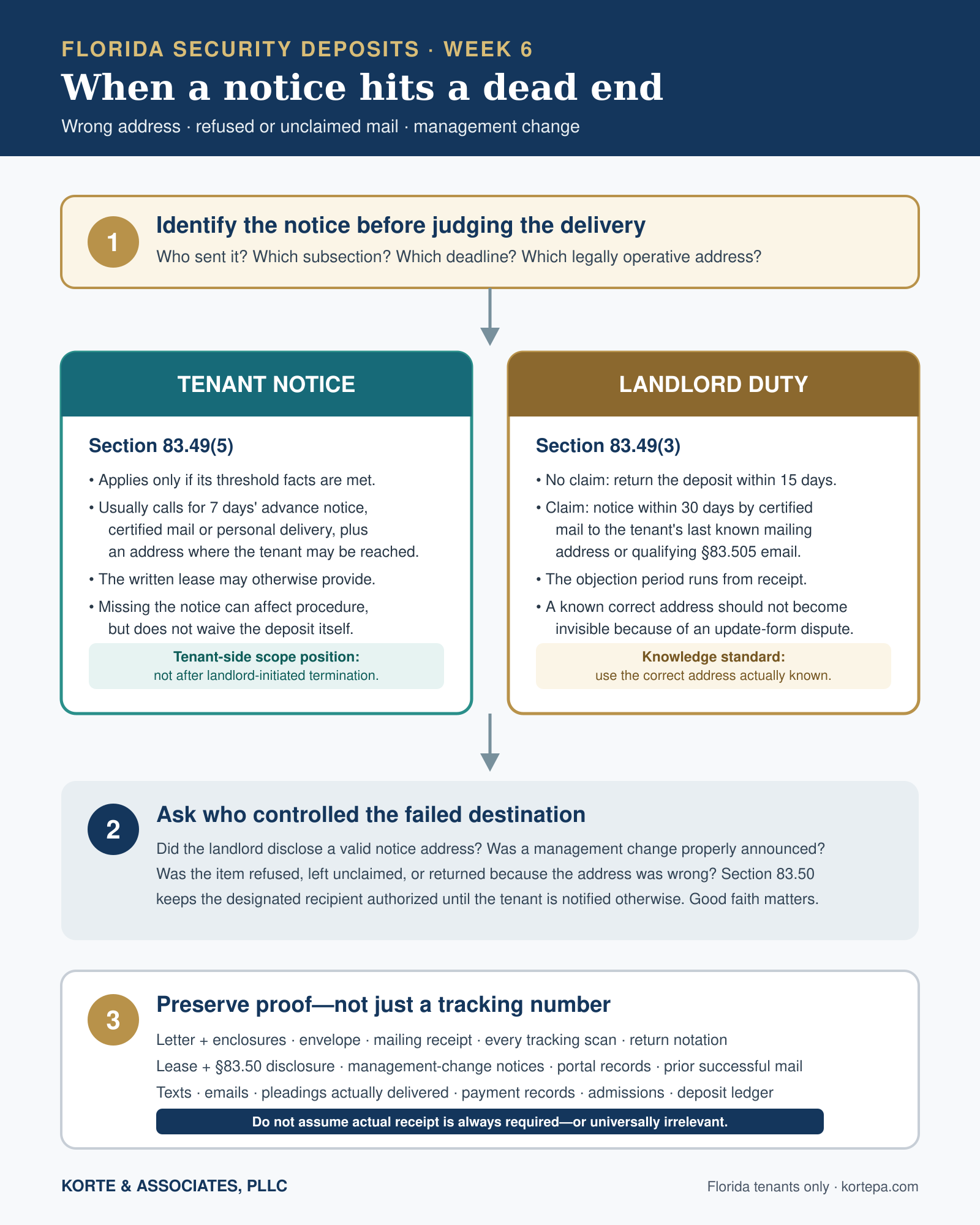
The first question is not simply whether the letter arrived. It is which duty was being performed, where the law directed the notice, and what the evidence shows about the failed delivery.
A wrong or obsolete landlord address is not merely the tenant's problem
Section 83.50 requires the landlord, or the person authorized to enter the rental agreement, to disclose in writing the name and address of the landlord or someone authorized to receive notices and demands. The designated recipient's authority continues until the tenant is notified otherwise. Changes must be delivered to the tenant's residence, another address the tenant specified in writing, or by qualifying email under section 83.505.
That rule matters when a lease names one office, a portal names another, and a new management company quietly takes over. If the landlord never properly replaces the designated recipient, the statute gives the tenant a substantial argument that the former recipient remained authorized. The landlord should not be able to keep an obsolete address in circulation and then use the predictable return of the tenant's letter as a procedural trap.
Section 83.44 supplies a related principle: every rental agreement and every duty in Part II of chapter 83 carries an obligation of good faith in performance and enforcement. Good faith does not automatically cure a defective method or create a new method of service. It does, however, weigh against an interpretation that rewards a party for making compliance needlessly impossible.
Management changes require a handoff of deposit records
Section 83.49(7) addresses a sale, title transfer, or change in the designated rental agent. The deposit and an accurate accounting must be transferred to the new owner or agent. The statute creates a limited rebuttable presumption that the successor received up to one month's rent, but it does not excuse earlier violations.
A management transition therefore should not erase address updates, forwarding instructions, certified-mail tracking, or the deposit ledger. Tenants should ask for the effective date of the change, the identity of the former and new agents, the written notice announcing the change, and records transmitted between them. If the old manager accepted the tenant's notice while still authorized, the owner may have difficulty treating that communication as though it never existed.
Refused and unclaimed certified mail require a fact-specific analysis
Postal tracking may show “refused,” “unclaimed,” “return to sender,” “insufficient address,” “vacant,” or repeated delivery attempts. Those events are not interchangeable. A refusal can suggest a conscious choice by someone at the destination. “Unclaimed” may show that notice was left but the item was not retrieved. An address problem may point back to the sender's mistake—or to outdated information supplied by the recipient.
No reported Florida appellate decision appears to establish one universal rule for every refused or unclaimed letter under section 83.49. Courts can examine statutory text, the selected address, the required delivery method, the lease, section 83.50's designation rule, the parties' prior course of dealing, and evidence of good faith. A tenant should not concede that refusal automatically defeats the notice. At the same time, a mailing receipt by itself may not prove the contents, the destination's legal status, or timely personal delivery.
When time remains, practical redundancy is valuable. Keep the certified-mail attempt, make a documented personal delivery to an authorized recipient if subsection (5) governs, and send a courtesy copy through channels the parties actually use. A courtesy email, text, or portal upload may prove knowledge even when it is not the statutory delivery method. If the parties signed the special addendum required by section 83.505, qualifying email may independently count; the sender must preserve the message and transmission evidence, and a returned-undeliverable email is not deemed delivered.
Wootton requires care, but it does not decide every failed-delivery question
In Wootton v. Iron Acquisitions, LLC, 338 So. 3d 425 (Fla. 2d DCA 2022), the landlord sent a claim letter to the tenants' attorney, and the letter omitted the required objection warning and the address for objections. The Second District held that strict compliance with section 83.49 was required before the landlord could retain part of the deposit.
Wootton is strong authority against treating a substantially defective landlord claim notice as “close enough.” But it did not decide whether a tenant's timely, correctly addressed certified letter becomes ineffective solely because the landlord refuses or does not claim it. Nor did it decide whether subsection (5) governs after landlord-initiated termination. The case should be applied to the duty and defect it actually addressed.
Subsection (5) matters only if its threshold applies
Subsection (5) covers a tenant who “vacates or abandons” before the fixed term expires and tenants who vacate or abandon periodic tenancies. Korte & Associates' tenant-side position is that this formal advance-notice rule does not govern after the landlord has already terminated the rental agreement and demanded possession. Section 83.56(6) directs the landlord to comply with subsection 83.49(3) when the rental agreement is terminated. A landlord should not be able to demand possession in three days and then complain that the tenant did not give seven days' advance warning before obeying.
This precise conflict remains unsettled.
Plakhov v. Serova, 126 So. 3d 1221 (Fla. 4th DCA 2012), and
Martinez v. Roads Point Townhomes, Inc., 395 So. 3d 667 (Fla. 3d DCA 2024), recognize subsection (5)'s procedural consequence on their records. They do not squarely analyze a landlord-initiated termination under section 83.56(6). The safer tenant practice is to provide a forwarding address promptly and preserve proof, while retaining the legal argument that subsection (5) never governed the departure.
“Last known mailing address” should turn on actual knowledge
For the landlord's 30-day claim notice, subsection 83.49(3)(a) uses the tenant's “last known mailing address.” Korte & Associates' tenant-side position is that this phrase imposes a knowledge standard. The controlling destination is the correct mailing address actually known to the landlord, regardless of whether the landlord learned it through a preferred form, certified mail, a lease notice channel, a particular office, or an express acknowledgment.
Knowledge can be proved by more than one document. Correspondence, pleadings actually delivered to the landlord or counsel, payment records, texts, emails, prior successful mailings, property-management notes, resident ledgers, deposition or trial admissions, and tracking documents can show what the landlord knew and when. A landlord's denial is evidence to test, not a power to erase contrary proof.
Once the landlord knows the correct updated mailing address, the tenant-side position is that both the claim notice and the return of the deposit are due there. That address can also affect where payment was to be made, but the complete venue analysis—including Florida Small Claims Rule 7.060(a)(7)—is reserved for a later installment. A plaintiff should not rely merely on an assignee's office location.
Pierre Woodland and Motif are narrow delivery-and-venue decisions
Pierre Woodland Meadows, LLC v. KAC 2021-1 LLC, 377 So. 3d 625 (Fla. 4th DCA 2024), involved an address-change filing in a separate eviction case that had not been served on the landlord at the lease address. The tenant later acted without counsel and settled, and the court concluded that the landlord properly used the last known address shown by that record.
The substituted opinion in Motif Apartments LLC v. Tenant's First, LLC, 418 So. 3d 200 (Fla. 4th DCA 2025), likewise treated an updated-address filing as ineffectual because it was not mailed to the landlord at the lease address. On clarification, the court withdrew its original opinion and omitted the earlier statement relying on subsection (5). The substituted opinion remained a venue ruling based on the delivery record before it.
These cases warn that an unserved docket filing may not prove knowledge. They do not replace the statutory phrase “last known mailing address” with a universal rule that only one form, one office, or one certified-mail path can ever establish the landlord's knowledge. If the landlord actually received, used, or admitted the correct address through another reliable source, those are materially different facts.
Build a delivery record that answers the real questions
- Save the exact contents. Keep a signed copy of the letter, every enclosure, the envelope, and the address label. A receipt proves little about what was inside unless the contents are also preserved.
- Capture the entire tracking history. Download or print each scan event, delivery attempt, refusal, nonclaim notation, and return date. Do not rely only on a later summary screen.
- Prove why the destination was used. Preserve the lease, section 83.50 disclosure, management notices, portal screenshots, letterhead, payment instructions, business records, and prior successful mail.
- Document actual knowledge of the tenant's address. Keep correspondence, pleadings delivered to the landlord or counsel, checks, settlement papers, emails, texts, prior mailings, property-management records, testimony, admissions, and tracking documents.
- Show the termination sequence. Save the landlord's notices, eviction complaint, summons, judgment, writ, settlement, surrender agreement, key receipt, and move-out communications. These facts bear on whether subsection (5) applied at all.
- Preserve management-transfer evidence. Identify both agents, when authority changed, whether the tenant was notified, and which deposit and address records were transferred.
- Use a second lawful route when possible. If a deadline is still open, consider documented personal delivery, qualifying electronic delivery under section 83.505, or another method permitted by the lease and statute. Keep courtesy copies separate from the method claimed as legal compliance.
Frequently Asked Questions
What if certified mail to my landlord is returned or unclaimed?
Keep the unopened returned envelope, receipt, tracking, contents, and proof that you used the legally designated address. The return notation can be important evidence, but it does not supply one automatic rule for every case.
Can a landlord change property managers without telling me where to send notices?
Section 83.50 says the designated recipient remains authorized until the tenant is notified otherwise. An undisclosed transition should not be used to manufacture a notice failure.
Does subsection (5) always require a seven-day letter after an eviction?
Korte & Associates' tenant-side position is no. Subsection (5) should apply only when its threshold facts are met, not after landlord-initiated termination. The precise interaction remains unsettled.
Must the landlord use my updated address if it learned the address informally?
The tenant-side position is that “last known mailing address” turns on the correct address actually known to the landlord, not on a universal update form. Preserve proof of what the landlord received or used.
Does refusing a certified letter count as receipt?
No reported Florida appellate decision appears to announce a universal answer for every section 83.49 notice. The notice, method, address, tracking, and conduct that caused the failure all matter.
Can ordinary email replace certified mail?
Not automatically. Section 83.505 permits electronic delivery when the parties signed its required voluntary addendum and designated valid email addresses. Otherwise, email may be evidence without satisfying the statutory method.
Authoritative sources
- Fla. Stat. § 83.49 (2026) — return, claim notice, tenant notice, and management-transfer rules.
- Fla. Stat. § 83.50 (2026) — disclosure and continuing authority of the landlord's notice recipient.
- Fla. Stat. § 83.505 (2026) — voluntary electronic delivery addendum and transmission records.
- Fla. Stat. § 83.44 (2026) — obligation of good faith.
- Fla. Stat. § 83.56(6) (2026) — landlord compliance with subsection 83.49(3) after termination.
- Wootton v. Iron Acquisitions, LLC, 338 So. 3d 425 (Fla. 2d DCA 2022).
- Pierre Woodland Meadows, LLC v. KAC 2021-1 LLC, 377 So. 3d 625 (Fla. 4th DCA 2024).
- Motif Apartments LLC v. Tenant's First, LLC, 418 So. 3d 200 (Fla. 4th DCA 2025) (substituted opinion).
- Martinez v. Roads Point Townhomes, Inc., 395 So. 3d 667 (Fla. 3d DCA 2024).
- Plakhov v. Serova, 126 So. 3d 1221 (Fla. 4th DCA 2012)
Continue the series
- Florida Evictions and Security Deposits: The Complete Guide to Section 83.49(5)
- Does Florida Statute 83.49(5) Apply After an Eviction?
- What “Last Known Mailing Address” Means Under Florida Security-Deposit Law
- What Happens When a Florida Landlord Misses the 30-Day Deposit Notice Deadline?
- Can a Florida Lease Override a Tenant's Security-Deposit Rights?
- Florida Security-Deposit Recovery for Tenants
Editorial and legal-information disclosure: This page provides general Florida legal information and presents identified tenant-side interpretations of unsettled questions. It is not legal advice for a particular matter and does not create an attorney-client relationship. The facts, lease language, delivery records, procedural posture, and later authority may change the analysis. Korte & Associates represents Florida tenants exclusively.