
|
RESOURCES
Where Can a Florida Tenant Sue for a Security Deposit? Venue, Address Knowledge, and Place of Payment
|
Where Can a Florida Tenant Sue for a Security Deposit? Venue, Address Knowledge, and Place of Payment
By
Brian K. Korte, Esq. · Published October 6, 2026 · Substantively updated October 6, 2026
Short Answer:
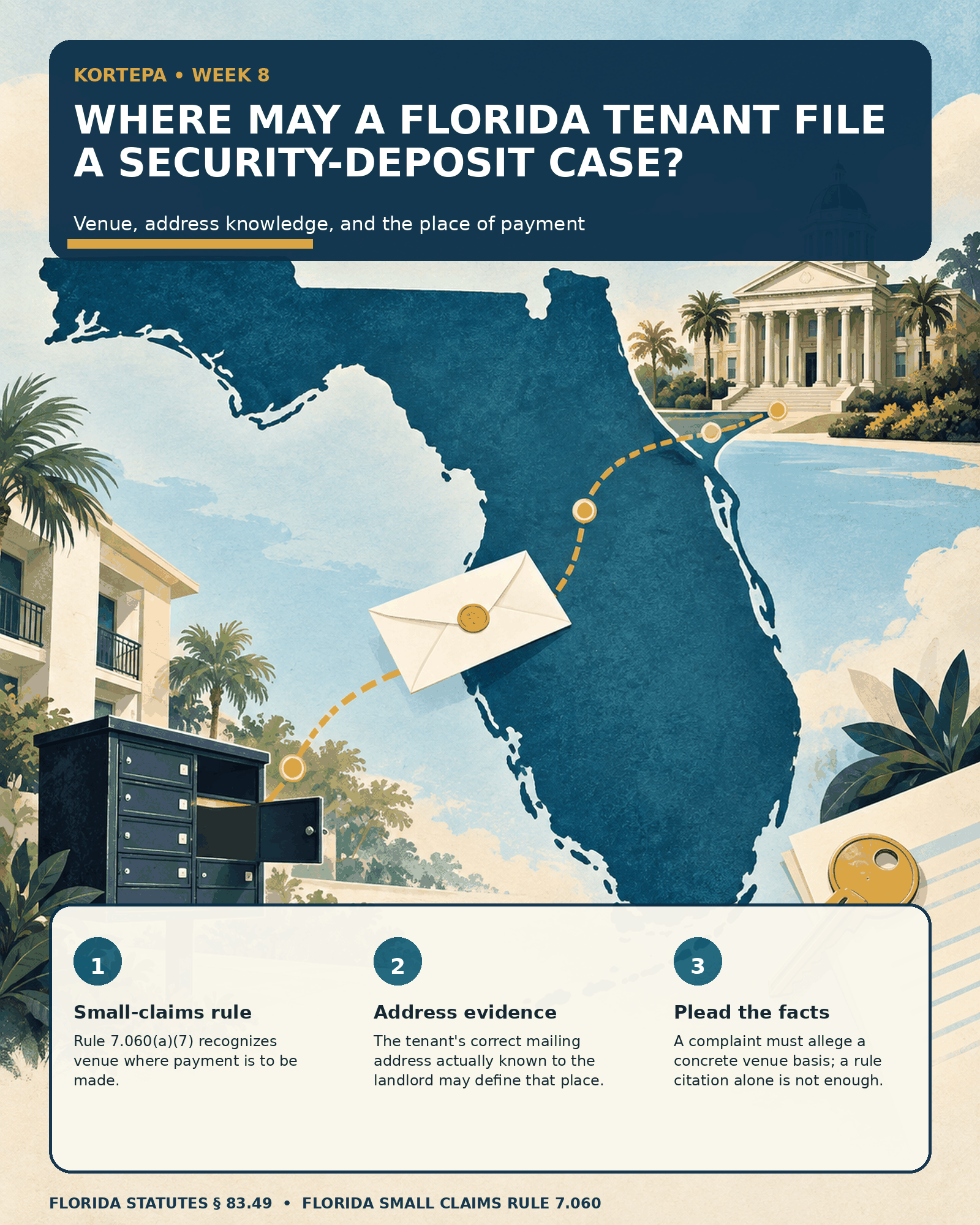
Florida Small Claims Rule 7.060(a)(7) applies to small-claims security-deposit actions and recognizes venue, when there is no contractual venue agreement, where payment is to be made. A tenant may therefore have a good-faith argument that the deposit was payable at the tenant's correct mailing address actually known to the landlord. But that result is not automatic. The complaint must allege the facts supporting the selected county, and recent Fourth District decisions reject venue based on a generalized rule citation or an assignee's office alone.
The hard question is how section 83.49's mailing duties identify the place of payment. Korte & Associates' tenant-side position is that “last known mailing address” in section 83.49(3)(a) creates a knowledge standard. Once the landlord actually knows the tenant's correct updated mailing address, the statutory claim notice—and, when no valid claim exists, return of the deposit—should be directed there. That address may support venue under Rule 7.060(a)(7). The appellate decisions do not yet establish that proposition for every record, so it must be pleaded with particular facts and identified as an unsettled application.
|
Venue asks where the lawsuit belongs
Venue is different from subject-matter jurisdiction. Jurisdiction asks whether the court has authority over the type and amount of the dispute. Venue asks which county is a legally proper location for the case.
Florida Statute section 47.011 generally allows an action where the defendant resides, where the cause of action accrued, or where the property in litigation is located. A corporate defendant may also implicate section 47.051. Small-claims cases add the venue notice in Rule 7.060(a), which lists seven potentially proper locations.
The Small Claims Rules apply to county-court actions demanding no more than $8,000, excluding costs, interest, and attorney's fees. A larger county-court deposit case may be governed by the general venue statutes and other applicable procedural rules rather than Rule 7.060's small-claims framework.
Rule 7.060(a)(7) expressly recognizes the place of payment
Rule 7.060(a) tells a small-claims defendant that venue may be proper in several places, including where the contract was made, where the event giving rise to the suit occurred, where a defendant resides, any location agreed to in the contract, and—in an action for money due with no venue agreement—where payment is to be made.
Subdivision (a)(7) matters in a deposit case because the tenant seeks money the landlord was obligated to return. The place where that payment was due can be part of where the cause of action accrued. The rule therefore cannot be treated as irrelevant merely because the rental property and landlord are in a different county.
The rule is a venue category, not a pleading shortcut. A complaint should identify the controlling address, explain why the landlord knew it, allege why the deposit became payable there, and connect those facts to the selected county.
Section 83.49 supplies the payment duties
Section 83.49(3)(a) creates two paths after termination of the rental agreement. If the landlord does not intend to impose a claim, the landlord must return the security deposit, with required interest, within 15 days. If the landlord intends to impose a claim, the landlord must provide the statutory notice within 30 days by certified mail to the tenant's “last known mailing address,” or by qualifying email under section 83.505.
If a required claim notice is not timely provided, the landlord forfeits the right to impose a claim on the deposit and may not seek a setoff against it. The landlord may still file a separate damages action after returning the deposit. Section 83.49(3)(c) separately authorizes an action to adjudicate the parties' right to the security deposit.
Those provisions make the deposit a payment obligation. The remaining venue question is where that payment was to be made. The statute expressly names the mailing destination for the claim notice but does not contain a separate sentence naming the delivery address for the 15-day return. The tenant-side argument links the duties: the same correct address actually known to the landlord is the natural statutory destination for both the notice about the money and the money itself.
“Last known mailing address” should turn on actual knowledge
Section 83.49(3)(a) does not say “the address submitted on the landlord's form,” “the address certified by the tenant,” or “the address acknowledged by management.” It says “last known mailing address.” Korte & Associates' tenant-side position is that the ordinary meaning imposes a knowledge standard: the controlling address is the tenant's correct mailing address actually known to the landlord, regardless of how the landlord learned it.
Evidence of that knowledge may include:
- correspondence sent to or received from the tenant at the updated address;
- pleadings, stipulations, discovery, or other litigation documents actually delivered to the landlord or counsel;
- checks, payment records, applications, ledgers, and account records;
- texts, emails, portal messages, and written management communications;
- prior mailings the landlord successfully sent to the updated address;
- property-management records and records transferred during a management change;
- deposition testimony, trial testimony, stipulations, or admissions; and
- certified-mail receipts, tracking histories, returned envelopes, and delivery scans.
The source of knowledge affects proof, but should not change the statutory meaning. Once the landlord knows the correct updated address, an obsolete address should not remain “last known” merely because the tenant did not use the landlord's preferred update channel.
Actual knowledge is not the same as universal actual-receipt requirement
A tenant alleging venue must prove more than that an address appeared somewhere. But the analysis should not be converted into a universal rule that the landlord must formally acknowledge or physically sign for every communication before knowledge can exist.
Delivery facts are evidence. They may show that the landlord received the address, that an agent rejected or failed to claim mail, that management used an obsolete office, or that records were not transferred after a change in management. A wrong landlord address, refusal, nonclaim, or management transition should not automatically let the landlord benefit from a delivery failure it created. At the same time, placing an address only in a court file or sending it to the wrong person may fail to prove landlord knowledge.
The correct inquiry is record specific: what address did the landlord or authorized agent actually know, when did it become known, and what reliable evidence proves that knowledge?
Pierre Woodland is important adverse authority—but narrow
In Pierre Woodland Meadows, LLC v. KAC 2021-1 LLC, the assignee filed the security-deposit action in Palm Beach County, where the assignee maintained its office. The Fourth District transferred the case to Broward County. The apartment, contract formation, cause of action, and lease-required notice and payment location were in Broward.
The court also rejected reliance on a notice of change of address filed in the separate eviction case. On that record, the notice had not been served on the landlord at the address required by the lease; the tenant later proceeded without counsel and settled; and the court found that the landlord properly mailed its claim notice to the tenant's last known mailing address.
Pierre Woodland defeats the proposition that an assignee can create venue merely by maintaining an office in another county. It also shows that filing an address in a separate case does not necessarily prove that the landlord knew it or that payment became due there. The opinion does not hold that section 83.49(3)(a)'s “last known mailing address” always changes only through one formal notice method. Its result depended on the lease, delivery, settlement, and address record before the court.
The substituted
Motif opinion focuses on an ineffective address notice
The substituted opinion in Motif Apartments LLC v. Tenant's First, LLC likewise transferred a Palm Beach County deposit case to Broward County. The Fourth District expressly quoted Rule 7.060's place-of-payment category. It then held that the updated-address notice filed in the Broward eviction case had not been mailed to the landlord at the address specified in the lease and was ineffective. On that record, the place of payment did not change.
That is adverse authority when a tenant or assignee relies on an address notice that never reached the landlord through a reliable channel. But the holding should not be enlarged into a rule that knowledge acquired through email, payment records, prior successful mail, direct communications, admissions, or other competent evidence is legally invisible.
Motif decided whether the particular notice changed the place of payment; it did not rewrite the statute.
The 2026 cases make venue pleading critical
Casa Verde MHC, LLC v. Tenant's Rights LLC reversed because the face of the complaint did not allege a basis for venue in Palm Beach County. The complaint itself showed that the property, tenancy, and eviction were in Hillsborough County, and it did not allege that the corporate landlord maintained an office or agent in Palm Beach County.
In 31 Ford LLC v. Tenant's Rights LLC, the Fourth District again reversed a venue ruling. The court held that a generalized citation to Rule 7.060 was not enough; the complaint had to allege a sufficient factual basis for the selected county. A later confession-of-error decision, Khan v. Tenant's Rights LLC, followed those cases and transferred another action.
These decisions do not delete subdivision (a)(7). They require the plaintiff to use it correctly. A place-of-payment theory should be alleged with the address, county, timing, landlord knowledge, statutory obligation, absence of a contrary valid venue agreement, and facts showing that payment was due there.
Section 83.49(5) is a separate threshold issue
Section 83.49(5) ordinarily requires certain tenants who leave before a fixed term expires or leave a periodic tenancy to give at least seven days' written notice by certified mail or personal delivery before vacating, including an address where the tenant may be reached. If subsection (5) governs and the tenant does not comply, the landlord is relieved of paragraph (3)(a)'s claim-notice requirement, although the tenant's substantive right to the deposit is expressly preserved.
That formal notice rule applies only if subsection (5) governs the departure at all. Korte & Associates' tenant-side position is that it should not govern after landlord-initiated termination. Section 83.56(6) states that when the rental agreement is terminated, the landlord shall comply with section 83.49(3). A landlord who demanded possession, filed the eviction, obtained a judgment, or executed a writ already knows the tenancy is ending.
This statutory interaction remains unsettled. It must be analyzed separately from the factual question of what mailing address the landlord actually knew. A court should not import subsection (5)'s certified-mail or personal-delivery method into paragraph (3)(a) as the only possible way a landlord can learn an address when subsection (5) does not apply.
How to plead a place-of-payment theory
A complaint relying on Rule 7.060(a)(7) should allege facts, not conclusions. Depending on the record, useful allegations may include:
- the amount of the deposit and the agreement creating the obligation;
- the termination and move-out dates;
- whether the landlord made a timely statutory claim;
- the date the deposit became returnable;
- the tenant's correct mailing address and county;
- how and when the landlord or authorized agent actually learned that address;
- the records proving knowledge;
- why return of the deposit was due at that address;
- the absence or inapplicability of a contrary contractual venue provision; and
- the specific Rule 7.060(a) and statutory grounds supporting the selected county.
The tenant should attach or preserve the lease, address communications, claim notice, envelope, tracking, payment ledger, termination documents, and other core evidence. Venue may be decided early, before the merits of the deposit dispute.
Practical guidance for tenants
- Do not choose a county for convenience alone. The tenant's current home, lawyer's office, or assignee's office is not automatically a proper venue.
- Start with the lease. Identify venue, notice, payment, and address-change clauses, but also determine whether and how they interact with nonwaivable statutory rights.
- Build an address-knowledge timeline. List each communication, date, sender, recipient, method, address shown, and proof of delivery or use.
- Preserve landlord-created delivery failures. Keep proof of an incorrect or obsolete landlord address, refused or unclaimed certified mail, management changes, forwarding instructions, and returned envelopes.
- Plead the venue facts expressly. Do not rely on a bare statement that venue is proper under Rule 7.060.
- Keep alternative venue grounds distinct. Defendant residence, accrual, contract formation, contractual venue, and place of payment are different bases and should not be blurred together.
- Do not rely merely on the assignee's office. Pierre Woodland rejected that approach.
Frequently Asked Questions
Can I file where I now live?
Possibly, but not merely because you live there. You need a legally supported venue basis. In a qualifying small-claims action for money due, the place where payment was to be made may be proper under Rule 7.060(a)(7).
Does my updated mailing address determine the place of payment?
It may when the landlord actually knew the correct address and the deposit was due there. That is a tenant-side application of the statute and rule, not a universal holding already adopted for every factual record.
Is a citation to Rule 7.060 enough?
No. Casa Verde and 31 Ford require the complaint to allege a factual basis for the selected venue. State the address, county, knowledge facts, payment obligation, and connection to the claim.
Do Pierre Woodland and Motif require formal lease-channel service in every case?
No reported opinion states such a universal rule. Both decisions held that the address-delivery facts before the court were ineffective. They are adverse authority, but should be applied to comparable facts rather than substituted for the statutory words “last known mailing address.”
What if the landlord refused or did not claim certified mail?
Preserve the receipt, complete tracking, returned envelope, contents, correct destination, and proof of refusal or nonclaim. Those facts may support knowledge or defeat an argument built on a landlord-created delivery failure, but actual receipt is not a universal prerequisite for every legal proposition.
Does subsection 83.49(5) eliminate the place-of-payment argument?
Not automatically. First decide whether subsection (5) governs. The tenant-side position is that it should not govern after landlord-initiated termination. Even when it applies, the statute preserves the tenant's substantive right to the deposit.
Authoritative sources
- Fla. Stat. § 83.49 (2026) - return, claim notice, last known mailing address, setoff, litigation, and tenant notice.
- Fla. Stat. § 83.56(6) (2026) - compliance with section 83.49(3) after termination.
- Fla. Stat. § 47.011 (2026) — general venue statute.
- Fla. Stat. § 47.051 (2026) — actions against corporations.
- Fla. Sm. Cl. R. 7.010 and 7.060 (effective July 1, 2026) — small-claims scope and venue categories, including place of payment.
- Pierre Woodland Meadows, LLC v. KAC 2021-1 LLC, 377 So. 3d 625 (Fla. 4th DCA 2024).
- Motif Apartments LLC v. Tenant's First, LLC, 418 So. 3d 200 (Fla. 4th DCA 2025), substituted opinion.
- Casa Verde MHC, LLC v. Tenant's Rights LLC, 432 So. 3d 549 (Fla. 4th DCA 2026).
- 31 Ford LLC v. Tenant's Rights LLC, No. 4D2026-0312 (Fla. 4th DCA July 1, 2026).
Continue the series
- Florida Evictions and Security Deposits: The Complete Guide to Section 83.49(5)
- Does Florida Statute 83.49(5) Apply After an Eviction?
- What “Last Known Mailing Address” Means Under Florida Security-Deposit Law
- What Happens When a Florida Landlord Misses the 30-Day Deposit Notice Deadline?
- Can a Florida Lease Override a Tenant's Security-Deposit Rights?
- When Florida Security-Deposit Mail Fails: Wrong Addresses, Refused Letters, and Management Changes
- Does a Florida Eviction Judgment Let the Landlord Keep the Security Deposit?
- Florida Security Deposit Recovery
Editorial and legal-information disclosure: This page provides general Florida legal information and presents identified tenant-side interpretations of unsettled questions. It is not legal advice for a particular matter and does not create an attorney-client relationship. Venue depends on the complaint, amount in controversy, parties, lease, address evidence, delivery record, statutory notice issues, and later authority. Korte & Associates represents Florida tenants exclusively.