
Miami-Dade County · Tenants Only
Facing eviction in
Miami-Dade? Here's how it works in your county.
business days to respond after you’re served — weekends and legal holidays don’t count. Missing it can mean losing without a hearing.
LOCAL RULES
Four things that work differently in Miami-Dade
Florida eviction law is statewide (Chapter 83, Florida Statutes). How a case actually moves through court is local. Here’s what Miami-Dade tenants need to know.
Your case is heard in your district
Miami-Dade eviction cases are filed in the district where the rental property is located: one of several district courthouses or the downtown Justice Center. Your summons tells you which one. Going to the wrong building on deadline day costs time you don’t have.
Source: Miami-Dade Clerk of the Court, Landlord & Tenant Disputes
Court registry deposits: wire transfer only
If your landlord says you owe rent, you generally must deposit it into the court registry to keep your defenses. In Miami-Dade, the Clerk accepts these deposits only by wire transfer. ACH payments are rejected.
Source: Miami-Dade Clerk of the Court; §83.60(2), Fla. Stat.
Your summons may be in your language
The Clerk publishes the residential eviction summons in English, Spanish, Creole, and French. Whatever language your copy is in, the deadline is the same: 5 business days.
Source: Miami-Dade Clerk of the Court forms library
The Sheriff's Office enforces the writ
If the landlord wins, the court issues a writ of possession. Miami-Dade now has an elected Sheriff’s Office, which replaced the Miami-Dade Police Department starting in January 2025. The writ is posted at your door, and you get 24 hours’ notice before you can be removed.
Source: §83.62, Fla. Stat.
THE CLOCK
How a Miami-Dade eviction moves
Most cases follow this path. The gold step is where tenants most often lose cases they could have fought.
BEFORE FILING
Notice
Usually a 3-day notice to pay rent or move (weekends and holidays excluded). Lease violations use a 7-day notice.
FILING
Complaint filed
The landlord files in county court in the district where your rental is located.
SERVICE
You're served
Papers are handed to you or posted on your door. If posted, the Clerk also mails you a copy.
5 BUSINESS DAYS
Answer + deposit
File a written answer and wire the rent into the registry (or file a motion to determine rent).
COURT
Hearing or ruling
The judge rules on the papers or sets a hearing. If no response was filed, the landlord can get a default.
AFTER JUDGMENT
Writ: 24 hours
The Sheriff’s Office posts the writ. You have 24 hours before removal.
How long each step takes varies by case and courthouse. See our full Florida eviction timeline.
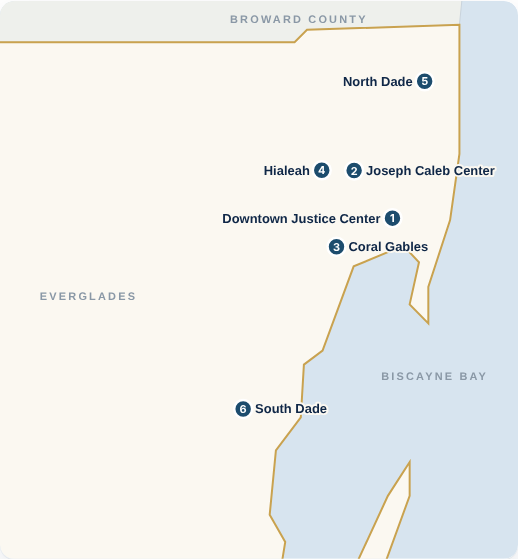
WHERE YOUR CASE IS HEARD
Miami-Dade courthouse locations
Miami-Dade County Court hears cases at the downtown Justice Center and at district court locations around the county. Check the address on your summons. If you aren’t sure, the Clerk’s office can tell you the right district.
1. Osvaldo N. Soto Miami-Dade Justice Center
20 NW 1st Avenue, Miami, FL 33128
2. Joseph Caleb Center Court
5400 NW 22nd Avenue, Suite 103, Miami, FL 33142
3. Coral Gables District Court
3100 Ponce de Leon Blvd., Coral Gables, FL 33134
4. Hialeah District Court
11 E. 6th Street, Hialeah, FL 33010
5. North Dade Justice Center
15555 Biscayne Blvd., Suite 100, North Miami, FL 33160
6. South Dade Government Center
10710 SW 211th Street, Suite 1200, Miami, FL 33189
The Miami Beach District Court is listed by the Clerk as temporarily closed. Use the Clerk’s Eviction Filing Court Location Finder to confirm your district. Map locations are approximate.
THE REGISTRY TRAP
Paying rent into the court registry in Miami-Dade
If your landlord sued for unpaid rent, Florida law generally requires you to deposit the rent the landlord says is owed, plus rent that comes due while the case is pending, into the court registry within 5 business days. If you don’t deposit it or file a motion asking the judge to decide how much is actually owed, you can lose every defense except payment, and the landlord can get a judgment without a hearing (§83.60(2), Fla. Stat.).
Don’t wait until day 5. Bank wires take time, and the Clerk says deposits are applied within 2 business days of receipt. Wires that can’t be matched to a case are sent back.
How a Miami-Dade registry deposit works
Complete the Clerk’s Wire Transfer Data Form online. It calculates your total, including the registry fee required by statute.
Send a wire transfer through your bank
using that information. ACH transfers are rejected. Your bank may charge its own wire fee.
Put the identifying details in the wire reference:
your case number, the party name, and an email. If someone else is paying for you, their name goes in too.
Keep proof
of the wire and the data form with your case papers.
Procedure as published by the Miami-Dade Clerk of the Court, October 2026. Procedures change. Confirm with the Clerk or with us before you send money.
KNOW YOUR LAW
What about Miami-Dade's Tenant Bill of Rights?
Miami-Dade County adopted its own tenant protections, often called the Tenant Bill of Rights. In 2023 the Legislature passed HB 1417, now §83.425, Florida Statutes. It makes residential landlord-tenant law a matter for the state, overriding local rules on notices, fees, and landlord and tenant rights and responsibilities.
What that means for your case: your defenses come from Chapter 83 of the Florida Statutes and the court rules, not from a county ordinance. The good news is that state law still gives tenants real protection. For example, your landlord cannot change the locks, shut off your utilities, or remove your belongings to force you out (§83.67). A landlord who does can owe you at least three months’ rent plus attorney’s fees.
¿Prefiere leer en español? Lea nuestra guía completa del proceso de desalojo en Florida. Guía de desalojo en español →
QUESTIONS
Miami-Dade eviction FAQ
I was served with eviction papers in Miami-Dade. How long do I have?
Five business days from the date you were served. Weekends and legal holidays don’t count. In that time you need to file a written answer with the court. If the landlord claims unpaid rent, you also need to deposit that rent into the court registry or file a motion asking the court to decide the amount.
How do I pay rent into the court registry in Miami-Dade?
The Miami-Dade Clerk accepts eviction registry deposits by wire transfer only. ACH is rejected. You fill out the Clerk’s Wire Transfer Data Form, which includes a registry fee, and then send a bank wire that references your case number and party name. Start early: the Clerk applies deposits within 2 business days of receipt.
Which courthouse is my eviction case in?
The case is filed in the district where the rental property is located. The courthouse is listed on your summons. You can also use the Clerk’s Eviction Filing Court Location Finder or ask a deputy clerk.
Does Miami-Dade’s Tenant Bill of Rights stop my eviction?
Usually not. Since 2023, §83.425, Florida Statutes, has given the state control over residential landlord-tenant law and overridden local rules on those subjects. Your defenses come from Chapter 83 and the court rules. Many tenants still have strong defenses under state law.
Can my landlord change the locks or turn off my utilities?
No. Florida law prohibits lockouts, utility shutoffs, and removing a tenant’s belongings to force them out (§83.67). Only a court-ordered writ, enforced by the Sheriff’s Office, can remove you. A landlord who violates this can owe you your actual and consequential damages or three months’ rent, whichever is greater, plus court costs and attorney’s fees.
Do I need to come to your office in Palm Beach Gardens?
No. We work with Miami-Dade tenants by phone, video, and our secure client portal, and our attorneys handle court appearances in your district.
What if I already missed the 5-day deadline?
Call right away. What can still be done depends on whether a default or judgment has been entered. Read what happens if you miss the 5-day deadline.
KEEP READING
Related Guides
KEEP READING
TIMELINE
AVOID
AFTER YOU MOVE
The 5-day clock is already running.
Tell us what’s happening and we’ll tell you where you stand. The case evaluation is free.